1

Practicable Socialism: Essays on Social Reform — A Closer Reading
(0 User reviews)
90
Project Gutenberg
2021
Not confirmed
Social problems; Great Britain -- Social conditions -- 19th century; Working class
Readers of public-domain and historical texts
Project Gutenberg digital edition
en
Edition facts
Words
71,635
Reading time
312 min
Text sections
18
The catalog record for Practicable Socialism: Essays on Social Reform — A Closer Reading provides practical reading context through 71,635 words, 5 hr 12 min estimated reading time, and 18 detected text sections.
The text analysis averages about 20.9 words per sentence, while the detected sections provide another way to judge how the source is divided.
Project Gutenberg metadata also associates the work with “Social problems,” connecting these edition facts with the source record’s subject description.
Source:
Project Gutenberg record #64263
A collection of essays by Samuel A. and Henrietta O. Barnett, drawing on fifteen years in East London to argue for social reforms grounded in the equal capacity for enjoyment, quiet action, and character development, with a distinctive dual-author voice.
Read the complete public-domain text at its original source.
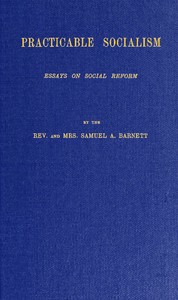
Read on Project GutenbergPracticable Socialism: Essays on Social Reform opens with a striking claim: the essays were written “out of the fulness of the moment” to give voice to needs the authors became conscious of during fifteen years in East London. Samuel A. and Henrietta O. Barnett do not present a systematic program; instead, they offer themselves as interpreters of “the dumb poor.” The introduction establishes two key principles: the equal capacity of all to enjoy the best, and the superiority of quiet ways over striving. Each essay is signed by one author, yet the preface insists they represent “common thought” and “common work.” This dual authorship creates a layered narrative voice—sometimes pastoral, sometimes statistical—that shifts between moral exhortation and detailed social observation.
A Voice from East London
The Barnetts ground their authority in lived experience, not abstract theory. The introduction states the essays were written at different intervals during their residence, and they “do not pretend to set forth any system.” Instead, the collection is framed as a response to requests from those who found the essays “some guide in the ways of service.” This origin story shapes the book’s tone: it is urgent but not dogmatic, personal but not confessional. The authors repeatedly stress that their understanding came from proximity—from being in a place where poverty was not a concept but a daily reality. The phrase “voice of the dumb poor” is carefully chosen; it implies both advocacy and limitation. The Barnetts claim to speak for others, but they also acknowledge that their own “shortcomings and failure” are due to “want of wisdom and of faith.” This humility is a recurring note, tempering the reformist zeal with a sense of fallibility.
The Workhouse as Rubbish-Heap
Henrietta O. Barnett’s essay on young women in workhouses deploys a deliberately harsh metaphor: the workhouse is a “sad rubbish-heap of humanity.” Yet she immediately complicates this image by noting that “it is not all worthless.” The essay moves from grim description to pointed critique. She reports that in seven East London unions, 253 young girl-mothers entered infirmaries between June 1877 and June 1878. The numbers are precise, but the argument is moral: the lack of classification in workhouses means that vulnerable women are corrupted by association with “the criminal and wilfully idle.” Her prose shifts between statistical observation and empathetic appeal. She describes a young mother who, rather than endure the able-bodied house, goes out with her three-week-old babe, resolved to “get on” as best she can—a choice that often leads to “hopeless vice.” The essay does not offer a single solution but insists on the need for “wise help, wisely given.”
Art as a Witness to the Unseen
In a brief but striking passage, Henrietta O. Barnett turns to art as a counterweight to spiritual starvation. She quotes Mrs. Browning: “The artist keeps up open roads between the seen and the unseen. Art is the witness of what is behind the show.” This appears in an essay that argues for bringing art within reach of the poor, on the grounds that “ideas rich” cannot choose but understand if brought near. The language here is markedly different from the workhouse essay—more lyrical, more abstract. The shift in register is itself a point of interest: the same author who writes of “rubbish-heaps” also writes of “open roads.” The collection as a whole moves between these poles, alternating between the concrete and the ideal. The Barnetts seem to believe that social reform requires both clear-eyed diagnosis and a vision of what might be. Art, for them, is not a luxury but a necessity, a way to keep “a nation’s fading higher life” alive when other influences fail.
Readers approaching Practicable Socialism should attend to the shifts in voice between essays and within them. Samuel A. Barnett tends toward the homiletic, Henrietta O. Barnett toward the ethnographic, but both share a commitment to grounding argument in observation. The book rewards attention to its metaphors—rubbish-heaps, open roads, quiet ways—which carry much of its persuasive force. Because the essays were written over fifteen years, they also register changes in the authors’ thinking; the collection is less a manifesto than a record of evolving response to persistent problems.
Reading the Barnetts’ essays on quiet character and shared joy, I found myself drifting to a slighter book, a collection of sporting recollections. There’s a similar pulse there—not of reform, but of unhurried camaraderie and simple satisfaction. Both feel like gentle conversations overheard. I thought of Sporting Society; or, Sporting Chat and Sporting Memories, Vol. 2 (of 2) — A Reader’s Guide as a remembered afternoon, not an argument.
There are no reviews for this eBook.
There are no comments for this eBook.
Reader reflection
What was your reading experience?
Capture what you thought, learned, and would like to remember.
Your progress
0
/
10
2
How did the book work for you overall?
3
Would you encourage someone else to read it?
4
How easy was the book to follow?
5
Did you gain anything practical from the text?
6
Was the book moving at the right speed?
7
Did you relate to its people, ideas, or situations?
8
What was its emotional impact?
9
Which lesson or insight stayed with you?
10