1

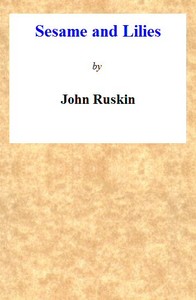
Sesame and Lilies — Reading Companion
(0 User reviews)
503
Project Gutenberg
1998
Not confirmed
Conduct of life; Social problems; Women; Books and reading -- Great Britain
Readers of public-domain and historical texts
Project Gutenberg digital edition
en
Edition facts
Words
51,996
Reading time
227 min
Text sections
5
This digital edition of Sesame and Lilies — Reading Companion is described by source-level measurements including 51,996 words, 3 hr 47 min estimated reading time, and 5 detected text sections.
The text analysis averages about 33.3 words per sentence, while the detected sections provide another way to judge how the source is divided.
Project Gutenberg metadata also associates the work with “Conduct of life,” connecting these edition facts with the source record’s subject description.
Source:
Project Gutenberg record #1293
John Ruskin's Sesame and Lilies, comprising three lectures on reading, women's roles, and life's mystery, reveals a self-revising author who, at fifty-one, re-evaluates his earlier style and religious views while defending chivalric ideals of feminine influence.
Read the complete public-domain text at its original source.
Read on Project GutenbergJohn Ruskin opens his preface to the later editions of Sesame and Lilies with a striking act of self-revision. At fifty-one, he declares himself unlikely to change his mind on important subjects, yet proceeds to disown large portions of his earlier work—especially on religion—as 'wholly mistaken.' He admits to having written with 'affected language' and a desire to be thought a fine writer, singling out his imitation of Richard Hooker in Modern Painters. This candid, almost clinical self-assessment sets the tone for a volume that is as much about the author's evolving voice as about its ostensible subjects: reading, womanhood, and the conduct of life.
A Conflicted Preface: Ruskin’s Revisions of Self
Ruskin’s preface is less an introduction to the lectures than a retrospective audit of his own corpus. He distinguishes between what he considers still valid—his writings on art, policy, and morality—and what he now rejects: his religious arguments, which he attributes to a 'narrow sect' education and 'oblique' reading of history. He plans to omit much from Modern Painters, The Seven Lamps, and The Stones of Venice, while republishing later works unchanged. This selective preservation reveals a writer acutely aware of his stylistic evolution: he notes that a young man 'necessarily writes otherwise than an old one' and declines to recast his 'juvenile language.' The preface thus becomes a meta-commentary on the difficulty of fixing one’s voice across a lifetime.
The Rhetoric of Obedience in Lecture II
In the excerpt from 'Lilies,' Ruskin mounts a defense of chivalric love that hinges on the word 'obedient.' He argues that the knight’s 'blind service to his lady' is not a romantic fiction but an 'eternal truth,' and that without such 'rapturous obedience,' all passion becomes 'wayward and wicked.' The passage is dense with rhetorical questions—'Are all these great men mistaken, or are we?'—and appeals to the authority of Shakespeare, Æschylus, Dante, and Homer. Ruskin’s prose here is emphatic, even hectoring, as he insists that a woman’s hand must 'brace' the soul’s armour. Yet the argument rests on a paradox: the lady’s command may be 'in caprice,' yet the knight must obey. This tension between ideal and practical submission marks the lecture’s most provocative strain.
Pace and Persuasion: From Confession to Command
The shift in pace between the preface and the lectures is pronounced. The preface moves slowly, with Ruskin weighing each clause—'I shall omit much, but not attempt to mend'—and building a careful, almost legalistic case for his new edition. In contrast, the lecture excerpt accelerates into a series of urgent questions and exclamations: 'Know you not those lovely lines—I would they were learned by all youthful ladies of England.' He inserts a poem mid-argument, breaking the rhythm to deliver a moral lesson in verse. This alternation between measured self-criticism and impassioned exhortation gives Sesame and Lilies a dual tempo: one voice reflects, the other commands. Readers may find the friction between these modes as revealing as the arguments themselves.
Evidence and Inference in Ruskin’s Argument
Ruskin’s method in the lecture is to pile up authorities—poets, historical practice, 'the human heart itself'—as if quantity of citation could substitute for logical proof. He asks whether Shakespeare and Homer are 'merely dressing dolls for us,' a rhetorical move that forecloses dissent. The evidence he offers is not empirical but literary and ideal: chivalry’s 'original purity' is invoked without historical detail. Readers should note that Ruskin’s claims about women’s guidance rest on a selective reading of medieval romance, not on the social realities of his own time. The excerpts do not show him engaging with counterexamples or practical objections, leaving his argument suspended between conviction and assertion.
Ruskin’s Sesame and Lilies rewards attention to its framing: the preface’s self-doubt complicates the lectures’ certainties. Readers may wish to compare the voice that disowns his earlier 'affected language' with the voice that later commands 'obedient devotion.' The tension between these two Ruskins—the reviser and the preacher—gives the book its peculiar energy. Approach the lectures not as settled doctrine but as a performance of persuasion by an author who, even as he revises, cannot resist the urge to instruct.
That rainy afternoon, Sesame and Lilies felt less like a lecture than a long, apologetic sigh—Ruskin unraveling his own certainties. Later, dusting my shelf, I stumbled on a different kind of quiet authority, wholly unapologetic. Zitkala-Ša’s voice held its own weather. The rain kept falling. I set Ruskin down and picked up American Indian Stories — Edition Insights, letting her world, and mine, slowly shift.
There are no reviews for this eBook.
There are no comments for this eBook.
Reader reflection
How did this book work for you?
Your answers remain private and are stored only in this browser.
Your progress
0
/
10
2
Was reading this book enjoyable?
3
How likely are you to recommend this book?
4
What was the reading difficulty like?
5
How strong was your personal connection to the text?
6
Did you gain anything practical from the text?
7
How strongly did the book affect you emotionally?
8
Could you see yourself revisiting this book?
9
Which lesson or insight stayed with you?
10