About 84 minutes
The Disadvantages and Opportunities of the Colored Youth — A Closer Reading
Historical Psychological Social Fiction
19,249 recorded words. 50 minutes difference from this book's estimate.
View Gutenberg source #59286
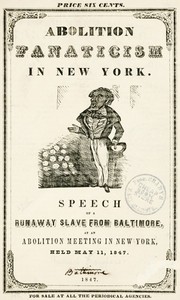
For Abolition Fanaticism in New York Speech of a Runaway Slave from Baltimore, at an Abolition Meeting in New York, Held May 11, 1847 — Story, Setting & Ideas, the stored edition analysis reports 7,692 words, 34 min estimated reading time, and 1 detected text section.
The text analysis averages about 25.2 words per sentence, while the detected sections provide another way to judge how the source is divided.
Project Gutenberg metadata also associates the work with “Antislavery movements -- United States,” connecting these edition facts with the source record’s subject description.
Explore this collection
These alternatives are selected using recorded categories and estimated reading time.
About 84 minutes
Historical Psychological Social Fiction
19,249 recorded words. 50 minutes difference from this book's estimate.
View Gutenberg source #59286About 133 minutes
Historical Psychological Social Fiction
30,504 recorded words. 99 minutes difference from this book's estimate.
View Gutenberg source #3390About 155 minutes
Historical Psychological Social Fiction
35,650 recorded words. 121 minutes difference from this book's estimate.
View Gutenberg source #10376Search stored excerpts and compare books → Choose by your preferences →
Choices use stored catalog measurements. Estimates vary with reading speed. A shared category is a catalog label, not a claim that two books have the same argument or literary quality.
Search reads excerpt text stored with this catalog and links to its associated Gutenberg record. The connection is stored in the site database; this tool does not recheck that every excerpt is word-for-word identical to that external record. Excerpt search does not cover every chapter and does not verify historical publication dates.
Catalog snapshot checked: 2026-09-25. Coverage: 93 public books, 93 available source excerpts.
Read the complete public-domain text at its original source.
Read on Project GutenbergFrederick Douglass's 1847 address, printed here as a six-cent pamphlet from the New-York Tribune, opens with a striking rhetorical posture: he warns his audience that both his manner and matter will disappoint. This is not false modesty but a calculated move to lower expectations while elevating the gravity of his subject. The speech is a transcript of an oral performance, preserving the rhythms of live oratory—interjections, cheers, and the speaker's own reported embarrassment. Douglass immediately establishes his authority not through eloquence but through experience: 'knowing what I have experienced in Slavery, knowing it to be a bad system.'
Douglass frames himself as 'a simple man' who speaks 'sober truths' rather than refined logic. This deliberate self-deprecation serves a dual purpose: it disarms critics who might expect bombast, and it aligns him with the plain-speaking tradition of moral witness. He acknowledges the 'extraordinary and unmerited eulogies' he has received, a rare moment of meta-commentary on his own celebrity. The text records that he was introduced by William Lloyd Garrison and greeted with 'enthusiastic and long-continued applause,' yet Douglass undercuts the ovation by insisting he is there to work, not to please. His opening sentences—'I am very glad to be here'—are repeated, creating a litany-like insistence that underscores his gratitude and resolve.
Douglass devotes substantial passages to rebutting American clergymen who spoke at the World's Temperance Convention and the Evangelical Alliance. He names Rev. Dr. Marsh, Rev. Mr. Kirk, and Rev. Doctor Cox, quoting their claims that slaveholders were 'peculiarly situated' and could not emancipate. Douglass counters with a specific fact: Gerrit Smith and Arthur Tappan had offered $10,000 to help slaveholders transport freed slaves, yet 'no such application was ever made.' This empirical refutation is delivered with sardonic restraint—'I do not mean to say that they would designedly tell that which is false'—leaving the implication of dishonesty to hang. The speech thus becomes a courtroom-style cross-examination of pro-slavery Christianity.
A key episode in the speech is Douglass's account of his appearance at the London World's Temperance Convention, where he 'palmed off his Abolition bombast' before 7,000 people—a phrase the pamphlet's editor uses derisively. Douglass reframes this as a providential opportunity: 'one of their number should be able to break his chains and burst up through the dark incrustations of malice and hate.' He contrasts the enslaved person, who 'sends no Delegates' to such gatherings, with the 'leprous pro-slavery distilment' poured into British ears by American ministers. The language is visceral—'chains are upon his arms, and fetters fast bind his limbs'—and the imagery of bursting through incrustations suggests both physical escape and rhetorical breakthrough.
Douglass personifies slavery as a mobile, invasive force: 'Slavery goes out in the Cambria and comes back in the Cambria.' The steamship Cambria, which carried delegates to the World's Temperance Convention, becomes a symbol of how slavery travels with its apologists. He extends this to the Evangelical Alliance, where slavery appeared 'looking saintly' in the person of Rev. Doctor Smythe. The speech's structure mirrors this pervasiveness: Douglass moves from the New York Tabernacle to London to the American South, showing slavery as a transatlantic system. His closing lines—'Slavery is everywhere'—are not hyperbole but a thesis supported by the preceding catalogue of clerical hypocrisy and Northern complicity.
Readers should attend to the editorial framing of this pamphlet: the title page calls it a 'Flaming Abolition Speech' and the prefatory note invites Marylanders to see 'how a runaway slave talks.' This hostile framing is at odds with Douglass's measured, evidence-driven argument. The speech rewards attention to its rhetorical strategies—the use of repetition, direct address, and factual rebuttal—as well as its historical context as a document of the transatlantic abolitionist movement.
That gray afternoon, Douglass’s speech made me sit with the weight of a nation’s contradictions. His voice felt immediate, almost in the room. Later, rain blurred the window, and I drifted to The lost Atlantis, and other ethnographic studies — Edition Insights. Strange bedfellow, perhaps, but both ask how stories become truth—one through testimony, the other through myth. I lingered on that thought until the rain stopped.
Create a short personal record of your experience with this book.