1

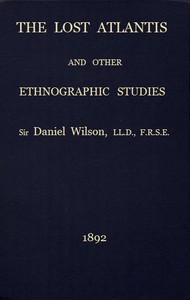
The lost Atlantis, and other ethnographic studies — Edition Insights
(0 User reviews)
141
Project Gutenberg
2016
Not confirmed
Atlantis (Legendary place); Indians of North America -- Antiquities; America -- Antiquities; Ethnology -- America
Readers of public-domain and historical texts
Project Gutenberg digital edition
en
Edition facts
Words
158,111
Reading time
688 min
Text sections
22
The catalog record for The lost Atlantis, and other ethnographic studies — Edition Insights provides practical reading context through 158,111 words, 11 hr 28 min estimated reading time, and 22 detected text sections.
The text analysis averages about 28.7 words per sentence, while the detected sections provide another way to judge how the source is divided.
Project Gutenberg metadata also associates the work with “Atlantis (Legendary place),” connecting these edition facts with the source record’s subject description.
Source:
Project Gutenberg record #51881
Eight monographs by Sir Daniel Wilson, linking the Atlantis legend to ethnographic studies of pre-Columbian America, with detailed analyses of Indigenous art, trade, and racial theories from a 19th-century diffusionist perspective.
Read the complete public-domain text at its original source.
Read on Project GutenbergThe volume opens with a preface written not by Sir Daniel Wilson but by his daughter Sybil, who describes the book as “a few carefully studied monographs, linked together by a slender thread of ethnographic relationship.” Wilson corrected proofs while gravely ill, and the preface records his final wish that Sybil write it. This personal framing sets a valedictory tone for a collection that ranges from the Atlantis myth to the aesthetic faculty of aboriginal races.
The first chapter, “The Lost Atlantis,” treats the legendary island-continent not as a literal lost world but as a recurring idea that has “awakened keenest interest” across centuries. Wilson’s approach is historical and ethnographic, tracing how the Atlantis story has been used to explain cultural similarities between Old and New World peoples.
Ethnographic Monographs and Their Thread
The eight studies cover distinct topics: the Atlantis legend, Norse Vinland, Stone Age trade, pre-Aryan American man, aesthetic faculty in aboriginal races, the Huron-Iroquois as a typical race, hybridity and heredity, and relative brain-weight and size. Wilson’s daughter notes that the thread linking them is “ethnographic relationship,” but the excerpts show a consistent interest in diffusion—how ideas, art styles, and technologies might have traveled across oceans or continents.
In the chapter on the aesthetic faculty, Wilson compares the art of different Northwest Coast tribes. He observes that the Algonkins “confine their art mainly to literal reproductions of natural objects,” while the Chimpseyans, Tawatins, and Clalam Indians “have developed a conventional style of art, often exhibiting much ingenious fancy.” This contrast between naturalism and conventionalism is a recurring analytical pattern.
Art as Evidence of Contact and Myth
Wilson devotes considerable attention to the carved claystone pipes of the Chimpseyans, noting that their “whimsical profusion of ornament” includes human figures, bears, frogs, and even European objects like log houses, horses, and fire-arms. He argues that these combinations are “referable to native myths” and that the native designer likely had “a special meaning, and even some specific incident in view.”
He draws an analogy to medieval Christian symbolism, where “conventional vines and lilies” or “dragons and snakes” carried hidden meaning. This comparison suggests Wilson sees Indigenous art as equally sophisticated in its symbolic language. He also notes that Marchand, a French navigator in 1791, believed Haidah carvings could be “distinctly traced to Aztec origin,” a claim Wilson reports without fully endorsing.
Race, Brain Size, and the Limits of Evidence
The final chapters address contentious 19th-century topics: hybridity, heredity, and relative brain-weight. Wilson’s chapter “Relative Racial Brain-Weight and Size” likely engages with craniometry, a pseudoscientific practice then used to rank races. The excerpts do not reveal his conclusions, but the inclusion of this study alongside aesthetic and historical ones shows the breadth of his ethnographic project.
Wilson’s tone is generally measured, and he often cautions against overinterpretation. In the aesthetic chapter, he warns that to the “unsympathetic observer,” Indigenous carvings may seem “a very arbitrary and even incongruous jumble,” but he insists on the presence of intentional meaning. This restraint contrasts with the more speculative diffusionist claims in the Atlantis chapter.
Readers should approach The Lost Atlantis as a product of its time, shaped by Victorian diffusionist debates and the emerging discipline of anthropology. Wilson’s strength lies in his detailed observations of material culture—pipes, masks, canoes—and his willingness to let artifacts speak. The volume rewards those who read across the monographs, tracing the slender thread of ethnographic relationship that Wilson and his daughter both acknowledged.
Some books stay close, like old friends whose voices you still hear. I finished the Atlantis monographs and found myself thinking about how Daniel Wilson saw echoes of distant worlds in everyday things. That same gentle ache of time passing came back to me reading My Mark Twain (from Literary Friends and Acquaintance) — Edition Insights—how Howells remembered Twain not as a legend, but as a man. Both left me feeling quietly grateful for the seeing.
There are no reviews for this eBook.
There are no comments for this eBook.
Reader reflection
Before you leave, reflect on the book
Use these questions to collect your thoughts before moving on.
Your progress
0
/
10
2
How much did you enjoy the reading experience?
3
Would you encourage someone else to read it?
4
What was the reading difficulty like?
5
Did the book meet your expectations?
6
Which aspect of the book did you value most?
7
Did you relate to its people, ideas, or situations?
8
How valuable was this book for your own interests?
9
In one sentence, what did you learn?
10