1

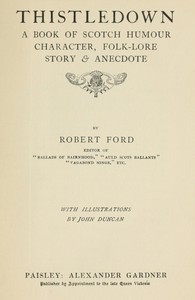
Thistledown: A Book of Scotch Humour, Character, Folk-lore, Story & Anecdote — Context and Discussion
(0 User reviews)
715
Project Gutenberg
2022
Not confirmed
Scotland -- Social life and customs; Scottish wit and humor; National characteristics, Scottish
Readers of public-domain and historical texts
Project Gutenberg digital edition
en
Edition facts
Words
115,277
Reading time
502 min
Text sections
26
The source record for Thistledown: A Book of Scotch Humour, Character, Folk-lore, Story & Anecdote — Context and Discussion measures this digital text at 115,277 words, 8 hr 22 min estimated reading time, and 26 detected text sections.
The text analysis averages about 22.5 words per sentence, while the detected sections provide another way to judge how the source is divided.
Project Gutenberg metadata also associates the work with “Scotland -- Social life and customs,” connecting these edition facts with the source record’s subject description.
Source:
Project Gutenberg record #67576
A collection of Scottish humour, character sketches, folklore, and anecdotes compiled by Robert Ford, drawing from rural and urban life, with illustrations by John Duncan. The excerpts reveal a focus on clan pride, linguistic play, and the unexpected settings where humour emerges.
Read the complete public-domain text at its original source.
Read on Project GutenbergRobert Ford's Thistledown presents itself as a gathering of Scottish humour, character, folklore, story, and anecdote, but the excerpts show a work more concerned with the social contexts that produce humour than with jokes alone. The preface argues that humour is a universal Scottish trait, 'part and parcel of his very being,' and that it 'slips out most frequently when and where least expected'—in kirk-sessions, courts, and even deathbeds. The anecdotes that follow bear this out, often hinging on clan loyalty, linguistic misunderstanding, or the collision of biblical knowledge with Highland pride.
Clan Pride as a Source of Humour
Several anecdotes in the excerpts turn on the tenacity of clan identity. In one, a Campbell and a M'Lean argue over which clan is older; the M'Lean insists his clan existed before the Flood, and when the Campbell points out that Noah's Ark had no M'Leans, the retort is: 'who ever heard of a M'Lean that had not a boat of his own?' The humour lies not in a punchline but in the logical twist that preserves clan honour. Another story involves the Earl of Airlie's pipers: an Ogilvie plays 'The Bonnie House o' Airlie' while a Campbell piper refuses, reportedly saying 'he would see your Lordship'—the rest lost in the skirl of pipes. These examples show how humour arises from deeply held social codes, not mere wit.
The Setting of Humour: From Ingle-Nooks to Holyrood
Ford's preface claims that humour 'blossoms in the solemn assemblies of the people' and 'issues from the village inn, the smiddy, the kirkyard.' The excerpts bear this out: the anecdotes are set in shops, deathbeds, and palace dining halls. The variety of settings underscores the claim that humour is not confined to one class or place. The deathbed anecdote, where a Highlander reluctantly forgives all enemies but one, shows humour emerging from a situation of solemnity—the clergyman's insistence on forgiveness meets Donald's stubbornness, producing a comic standoff. The effect is to present humour as a constant, unpredictable presence in Scottish life.
Linguistic Play and Misunderstanding
Several anecdotes rely on dialect, wordplay, or miscommunication. In one, Angus and Donald argue over cloth measurement: Angus insists a cloth of 'six-quarters' is more than a whole, while Donald points out that 'a fourth is a quarter, and five quarters would be more than the whole.' The humour comes from the clash between everyday logic and Angus's stubborn assertion of his own experience: 'I've seen too many snowy days not to know what I'll say.' The excerpts also include a quotation from Dr. Norman Macleod on the Highlander's long memory for insults, followed by a story that illustrates the point—the deathbed grudge. These passages show how language, both dialect and formal English, is used to frame character and conflict.
Readers approaching Thistledown should expect a collection that is less a joke book than a social document. The humour is embedded in narratives of clan, place, and speech, and often requires familiarity with Scottish institutions—kirk-sessions, the General Assembly, Highland clan structures. The excerpts suggest that Ford's aim is to preserve and display a national character through its own expressions, not merely to amuse. The book rewards attention to the settings and speakers as much as to the anecdotes themselves.
Years among these shelves, I’ve noticed how Thistledown finds laughter in the stubborn weave of folk—how the joke eases a hard life. Reading the quiet kinship there, I recall my worn copy of Essays in medical sociology, Volume 2 (of 2) — A Reader’s Guide, where healing, too, is a homely tale told among neighbours. Both whisper that we mend ourselves through shared speech.
There are no reviews for this eBook.
There are no comments for this eBook.
Reader reflection
Take a moment to reflect on this book
Create a short personal record of your experience with this book.
Your progress
0
/
10
2
Did this book hold your interest?
3
Would you encourage someone else to read it?
4
How easy was the book to follow?
5
What did you appreciate most?
6
How would you describe its reading pace?
7
Did any part of the book feel personally relevant?
8
How valuable was this book for your own interests?
9
What is the main idea you are taking away?
10