1

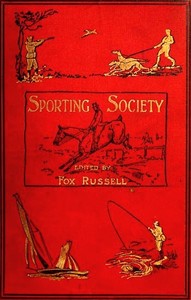
Sporting Society; or, Sporting Chat and Sporting Memories, Vol. 1 (of 2) — Background and Themes
(0 User reviews)
294
Project Gutenberg
2012
Not confirmed
Fishing -- Great Britain; Fox hunting -- Great Britain; Horse racing -- Great Britain; Hunting -- Great Britain
Readers of public-domain and historical texts
Project Gutenberg digital edition
en
Edition facts
Words
79,563
Reading time
346 min
Text sections
9
This digital edition of Sporting Society; or, Sporting Chat and Sporting Memories, Vol. 1 (of 2) — Background and Themes is described by source-level measurements including 79,563 words, 5 hr 46 min estimated reading time, and 9 detected text sections.
The text analysis averages about 23.6 words per sentence, while the detected sections provide another way to judge how the source is divided.
Project Gutenberg metadata also associates the work with “Fishing -- Great Britain,” connecting these edition facts with the source record’s subject description.
Source:
Project Gutenberg record #40301
This editorial note examines the structure, recurring images, and movement between scenes in the first volume of 'Sporting Society', a collection of hunting, racing, and fishing sketches edited by Fox Russell and illustrated by Randolph Caldecott.
Read the complete public-domain text at its original source.
Read on Project GutenbergThe first volume of Sporting Society opens not with a single narrative but with a publisher’s catalogue of sporting books, immediately establishing the work’s place within a specific literary marketplace. The editor, Fox Russell, presents a series of sketches that move between fox-hunting, steeplechasing, and fishing, each episode anchored by precise observations of terrain, horseflesh, and weather. The prose is brisk and detail-oriented, favouring concrete nouns—'bullfinch', 'post and rail', 'water'—over abstract reflection. This is a world where a rider’s skill is measured in inches and seconds, and where the landscape is read as a sequence of obstacles to be negotiated.
The Steeplechase as Structural Anchor
The most extended excerpt in the volume—a four-mile steeplechase—reveals the work’s characteristic structure: a linear, obstacle-by-obstacle progression that mirrors the race itself. The narrative follows a young officer riding a horse named Jerry, and the prose tracks each fence, each shift in pace, each rival’s move. The race is not merely described but paced: the reader is told of a 'slight ascent of about 300 yards' then a 'dead level of about a quarter of a mile'. This attention to measured distance and gradient gives the passage a documentary quality. The editor’s hand is light; the story unfolds through action and dialogue rather than authorial commentary. The race becomes a microcosm of the volume’s method: a series of discrete, vividly rendered moments linked by forward momentum.
Recurring Images: The Horse’s Body and the Rider’s Eye
Throughout the excerpts, the horse is never a mere vehicle but a creature of known habits and physical specifics. Jerry is described as having 'forelegs like steel'; another horse is noted for a 'dicky forelegs' that the rider hopes to exploit. The rider’s gaze is constantly assessing: 'I looked round to see who and what it was'. This mutual observation—rider watching horse, rider watching rival, horse responding to terrain—creates a network of glances and judgments. The landscape itself is anthropomorphized only rarely; instead, it is broken into functional parts: 'the descent to the stream', 'the grip in the fields'. The recurring image is not a single symbol but a pattern of practical attention: the weight of a rider, the condition of a fence, the angle of a jump.
Movement Between Scenes: From Guest Night to Race Day
The volume’s transitions are abrupt and purposeful. A single paragraph moves from 'the evening before the chase' with its 'grand guest night' to the race itself the next day. The social setting—officers gathered, Captain Lane’s 'contemptuous glance'—is sketched in a few lines, then abandoned for the physical action. This compression is typical: the editor does not linger on atmosphere or motive. The reader is expected to infer character from action. Captain Lane, for instance, is introduced through his look and his riding style: 'a great rush, evidently hoping to make him refuse'. The movement between scenes is thus a shift in register, from the social (salutations, enquiries) to the physical (the flag drops, the horse jumps). The effect is one of acceleration, as if the narrative itself is gathering speed.
The Role of the Spectator and the Unseen Narrator
Although the steeplechase is told in first person, the narrator often adopts the stance of a spectator, describing 'a ludicrous spectacle' of a rider on his horse’s neck or a horse that 'quietly took it standing, then putting down his head slipped his rider off'. This double perspective—participant and observer—allows the editor to include moments of comedy and mishap without breaking the narrative’s forward drive. The narrator’s voice is that of an experienced horseman, but he rarely editorializes. The result is a text that feels reportorial, even documentary. The volume’s other sketches, on fishing and hunting, likely employ a similar technique: a knowledgeable eye recording what it sees, with the editor’s role being one of selection and arrangement rather than interpretation.
Readers approaching this volume should attend to the way its editor, Fox Russell, builds each sketch around a specific physical challenge—a race, a hunt, a day’s fishing—and lets the action dictate the prose’s rhythm. The illustrations by Randolph Caldecott, though not reproduced in this digital edition, were presumably chosen to complement the text’s emphasis on movement and posture. The work rewards a slow reading that savours its concrete details: the weight of a saddle, the feel of a horse’s mouth, the colour of a stream. It is a book best read not as a continuous narrative but as a series of sharp, self-contained vignettes.
There’s a particular calm in the way Sporting Society moves between a rainy riverbank and a smoky stable-yard, each scene settling like a familiar chair. That unhurried rhythm reminded me of another book’s quiet attention to what we hold dear—the small rituals of land and memory. Great Possessions — Key Ideas to Explore lingers there too, gently.
There are no reviews for this eBook.
There are no comments for this eBook.
Reader reflection
Before you leave, reflect on the book
Use these questions to collect your thoughts before moving on.
Your progress
0
/
10
2
How much did you enjoy the reading experience?
3
Is this a title you would suggest to others?
4
How demanding did the text feel?
5
Which part made the strongest impression?
6
Was the book easy to understand?
7
Could you see yourself revisiting this book?
8
How well did it match your expectations?
9
Which lesson or insight stayed with you?
10