1

Partial Portraits — Story, Setting & Ideas
(0 User reviews)
226
Project Gutenberg
2018
Not confirmed
Stevenson, Robert Louis, 1850-1894; Emerson, Ralph Waldo, 1803-1882; Trollope, Anthony, 1815-1882; Du Maurier, George, 1834-1896; Eliot, George, 1819-1880; Literature, Modern -- 19th century -- History and criticism; Daudet, Alphonse, 1840-1897; Turgenev, Ivan Sergeevich, 1818-1883; Woolson, Constance Fenimore, 1840-1894; Maupassant, Guy de, 1850-1893
Readers of public-domain and historical texts
Project Gutenberg digital edition
en
Edition facts
Words
105,187
Reading time
458 min
Text sections
9
The source record for Partial Portraits — Story, Setting & Ideas measures this digital text at 105,187 words, 7 hr 38 min estimated reading time, and 9 detected text sections.
The text analysis averages about 26.6 words per sentence, while the detected sections provide another way to judge how the source is divided.
Project Gutenberg metadata also associates the work with “Stevenson, Robert Louis, 1850-1894,” connecting these edition facts with the source record’s subject description.
Source:
Project Gutenberg record #58471
Henry James's 1888 collection of literary portraits examines Emerson, Eliot, Trollope, Stevenson, Daudet, Maupassant, Turgenev, du Maurier, and others, with a preface noting the essays' periodical origins. James's critical voice balances admiration with precise observation, often focusing on the writer's method and the 'colour' of their work.
Read the complete public-domain text at its original source.
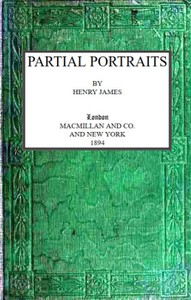
Read on Project GutenbergHenry James opens his 1888 collection Partial Portraits with a characteristic blend of critical precision and personal inflection. The volume gathers essays originally published in American and British periodicals, each a portrait of a literary figure. James immediately establishes his method: he praises Elliot Cabot's biography of Emerson as 'a model of responsible editing,' then pivots to note a 'singular impression of paleness' in Emerson's life, condensed into 'the single word Concord.' This move—from commendation to a nuanced, almost painterly critique—typifies James's approach throughout. He does not simply summarize; he evaluates the texture and tone of a writer's career, often using metaphors of visual art. The collection's title itself signals incompleteness: these are partial views, not definitive judgments.
The Critic as Painter: James's Visual Vocabulary
James repeatedly turns to the language of painting and color to describe literary effect. In the Emerson essay, he finds the biographer's page 'vacant' of 'colour,' a term he uses to denote vividness of incident. Later, discussing Alphonse Daudet, he remarks that 'if he paints with a pen he writes with a brush.' This is not mere decoration; James uses visual terms to diagnose what a writer achieves or lacks. He praises Daudet's ability to 'put his finger upon known examples,' suggesting a tactile, almost forensic quality in Daudet's realism. Conversely, he faults Emerson's biography for lacking 'the rapidity, or the complexity, that a spectator loves.' The critic positions himself as a spectator of literary careers, judging them by their capacity to hold attention through texture and incident.
The Ethics of Portraiture: Naming Names
James confronts the question of whether a critic should identify real-life models in fiction. In the Daudet essay, he lists several alleged originals—'The Nabob is François Bravais; the Duc de Mora is the Duc de Morny'—and notes that Daudet has been 'accused of the impertinence of insisting.' James does not settle the ethical debate; instead, he observes that 'putting people into books is what the novelist lives upon' and that the real issue is 'delicacy.' He refuses to pronounce on Daudet's conscience, but his own practice in these essays is notably discreet: he rarely names living persons beyond the subjects themselves. The tension between observation and discretion runs through the collection, as James weighs the critic's duty to describe against the subject's right to privacy.
Pace and the Periodical Essay
The essays in Partial Portraits vary markedly in length and tempo, reflecting their origins in different periodicals. The Emerson piece, the longest, moves slowly, dwelling on the 'vacancy' of a life without dramatic events. In contrast, the Daudet essay accelerates with lists of proper names and brisk judgments. James himself notes that the essay on Trollope was written 'immediately after his death' and before the publication of Trollope's autobiography, implying a hurried, reactive quality. The collection's structure—nine portraits plus a final essay on 'The Art of Fiction'—creates a rhythm of close reading followed by broader theoretical reflection. Readers may notice how James adjusts his own pace to match his subject: the Stevenson sketch, for instance, is dated and relatively short, while the Turgenev reminiscence is more leisurely and elegiac.
Reading Partial Portraits as a sequence rather than a miscellany reveals James's evolving critical priorities. He is less interested in biographical completeness than in capturing what he calls 'the tone of a particular pitch of manners.' The essays reward attention to their openings, where James often sets a metaphor or a reservation that the rest of the piece will develop. Because these are partial views, they invite the reader to compare James's judgments with the works themselves—a conversation that remains open.
Skimming Henry James’s Partial Portraits, I lingered on his tenderness for Turgenev’s quiet method, that unhurried patience with character. It reminded me, oddly, of an old volume I once held, The works of Richard Hurd, volume 6 (of 8) — A Reader’s Guide, where criticism also felt like conversation, not verdict. Both books seem to whisper, not lecture, across the years.
There are no reviews for this eBook.
There are no comments for this eBook.
Reader reflection
Record your reading impressions
A brief reflection can help important ideas stay with you longer.
Your progress
0
/
10
2
Did this book hold your interest?
3
Would you encourage someone else to read it?
4
How much effort did this book require?
5
How strong was your personal connection to the text?
6
Could you apply anything you learned?
7
Was the book easy to understand?
8
Did the book meet your expectations?
9
What did this book teach you most?
10