1

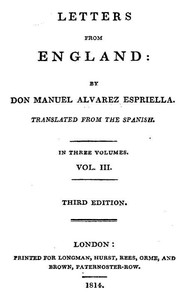
Letters from England, Volume 3 (of 3) — A Closer Reading
(0 User reviews)
956
Project Gutenberg
2020
Not confirmed
England -- Description and travel; England -- Social life and customs; Southey, Robert, 1774-1843 -- Travel -- England; Authors, English -- Travel -- England
Readers of public-domain and historical texts
Project Gutenberg digital edition
en
Edition facts
Words
64,111
Reading time
279 min
Text sections
25
Before opening Letters from England, Volume 3 (of 3) — A Closer Reading, the edition data offers a quick orientation: 64,111 words, 4 hr 39 min estimated reading time, and 25 detected text sections.
The text analysis averages about 28.2 words per sentence, while the detected sections provide another way to judge how the source is divided.
Project Gutenberg metadata also associates the work with “England -- Description and travel,” connecting these edition facts with the source record’s subject description.
Source:
Project Gutenberg record #61632
Robert Southey's third volume of fictional letters by a Spanish traveler dissects English society through observations on religion, popular amusements, and political tensions, with a distinctive blend of satire and moral critique.
Read the complete public-domain text at its original source.
Read on Project GutenbergThe third volume of Southey's fictional correspondence opens with a pointed contrast between Spanish and English religious practices. Don Manuel, the invented narrator, argues that the domestic reading of Scripture, while potentially harmful in Spain, has been beneficial in England—a claim that immediately establishes the work's comparative method. The letters that follow range from the credulity of the English public (the Wild Indian Woman, the Learned Pig) to the mechanics of newspaper falsification and the rise of commercial interests. Southey's persona maintains a tone of measured astonishment, using the foreign observer's perspective to critique customs that native writers might take for granted.
A Foreign Lens on English Credulity
Letter LV catalogs a series of public curiosities that reveal what Southey, through Espriella, considers a national weakness for the marvelous. The Wild Indian Woman, the Large Child, the Wandering Jew, the Ethiopian Savage, and the Learned Pig are presented not as isolated oddities but as symptoms of a culture that craves novelty. The narrator's tone is clinical, almost anthropological, as he records these phenomena without overt indignation. This restraint makes the critique more effective: the reader is left to infer the absurdity from the mere listing of attractions. The letter also touches on the role of newspapers in amplifying such credulity, a theme that recurs throughout the volume.
Newspapers, Reviews, and the Machinery of Opinion
Letter LVI offers a systematic dissection of the periodical press. Southey's narrator describes how newspapers falsify intelligence, how puffs and advertisements manipulate readers, and how reviews exert a 'mischievous' influence on literary reputation. The critique is specific: reviews are accused of creating or destroying authors based on faction rather than merit. The letter also addresses magazines and novels, though the excerpts provide only the headings. What emerges is a portrait of a society increasingly shaped by print media, where public opinion is manufactured rather than formed. Southey's own position as a reviewer and poet adds a layer of self-awareness to the attack.
Popular Amusements and National Character
Letter LXVII and the surrounding excerpts present a sustained argument about English brutality disguised as sport. Bull-baiting is condemned not only for its cruelty but for its cowardice—the men face no danger, unlike Spanish bull-fights. Boxing, or pugilism, is described as a 'savage art' with a technical vocabulary and a betting economy that mirrors national victories. Southey's narrator notes that these amusements flourish despite being illegal, which he takes as 'an irrefragable proof of national barbarity.' The critique extends to the lack of holidays, which forces the labouring class into riotous excess when they do occur. The voice is that of a Catholic Spaniard shocked by Protestant England's lack of festive restraint.
Prophets, Conspiracies, and the Threat of Revolution
The later letters turn to religious enthusiasm and political danger. Letter LXI discusses Despard's conspiracy and the question of revolution, while letters LXVIII through LXX examine the prophets Richard Brothers and Joanna Southcott, as well as the Abbé Barruel's theories. Southey's narrator treats these figures with a mixture of curiosity and alarm, seeing in them evidence of a society unmoored from traditional authority. The excerpts suggest that Southey is using the foreign observer to explore the boundaries between credulity and faith, and between legitimate dissent and sedition. The volume thus moves from social observation to political and religious commentary, maintaining the epistolary frame throughout.
Readers approaching this volume should attend to the consistency of Espriella's voice: he is neither a simple mouthpiece for Southey nor a naive traveler, but a carefully constructed persona whose judgments are shaped by his own cultural assumptions. The letters reward attention to their rhetorical strategies—the use of contrast, the accumulation of detail, the occasional flash of irony. Because the excerpts are incomplete, the full arc of the volume's argument remains partly conjectural, but the pattern of critique is clear enough to guide a first reading.
I keep thinking about how Southey's traveler saw England through such a tender, critical lens—not judging, just noticing. It reminded me of sitting with Among My Books. First Series — Text and Context, where the same quiet attention to old pages feels like a shared secret between friends. Both left a warmth that stays after the final line, like a lantern carried home.
There are no reviews for this eBook.
There are no comments for this eBook.
Reader reflection
Record your reading impressions
A brief reflection can help important ideas stay with you longer.
Your progress
0
/
10
2
Was reading this book enjoyable?
3
Would you recommend this book to another reader?
4
What was the reading difficulty like?
5
Do you expect to return to this book?
6
How did the pace of the book feel?
7
Which part made the strongest impression?
8
Did it raise ideas you would like to talk about?
9
In one sentence, what did you learn?
10