1

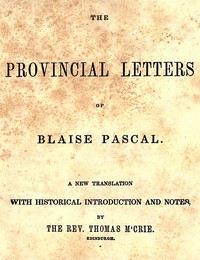
The provincial letters of Blaise Pascal — Inside the Classic
(0 User reviews)
187
Project Gutenberg
2024
Not confirmed
Jansenists -- France -- Early works to 1800; Port-Royal des Champs (Abbey) -- Early works to 1800; Jesuits -- Early works to 1800
Readers of public-domain and historical texts
Project Gutenberg digital edition
en
Edition facts
Words
150,890
Reading time
657 min
Text sections
28
For The provincial letters of Blaise Pascal — Inside the Classic, the stored edition analysis reports 150,890 words, 10 hr 57 min estimated reading time, and 28 detected text sections.
The text analysis averages about 26.2 words per sentence, while the detected sections provide another way to judge how the source is divided.
Project Gutenberg metadata also associates the work with “Jansenists -- France -- Early works to 1800,” connecting these edition facts with the source record’s subject description.
Source:
Project Gutenberg record #73959
Pascal's satirical letters expose Jesuit casuistry through sharp dialogue, ironic contrasts, and layered argumentation, using laughter as a weapon against moral laxity.
Read the complete public-domain text at its original source.
Read on Project GutenbergPascal opens his first letter not with abstract theology but with a report of a dispute in the Sorbonne over a single phrase: "proximate power." This term, invented by the Jesuits to secure the censure of Antoine Arnauld, becomes the first of many verbal traps Pascal will expose. His method is forensic: he quotes the Jesuits' own definitions, then lets their contradictions surface through the voice of a naive provincial correspondent who relays conversations with various theologians. The reader is drawn into a labyrinth of scholastic distinctions that, Pascal argues, are designed to evade moral accountability.
The Rhetoric of Irony and Dialogue
Pascal's most distinctive authorial choice is the use of a fictional provincial writing letters to a friend in Paris. This framing allows him to present theological debates as reported conversations, complete with interruptions, exclamations, and feigned bewilderment. In Letter I, the provincial recounts how a Jansenist explains that "proximate power" is a term "invented" to condemn Arnauld without addressing the substance of his views. The irony is layered: the provincial's naivete mirrors the reader's confusion, while Pascal's actual argument emerges through the contrast between the Jansenist's clarity and the Jesuit's obscurity.
The dialogue form also enables Pascal to deploy ridicule without appearing aggressive. When a Jesuit defends probabilism by citing Escobar, the provincial responds with mock admiration: "What! father, is it possible that you have such a number of authors on your side?" The surface compliment undercuts the authority of the casuists by reducing their arguments to a mere counting of opinions.
Diction and the Weapon of Laughter
Pascal explicitly defends his use of ridicule in Letter XI, citing Tertullian and Augustine to argue that laughter is a legitimate response to absurd opinions. He writes that "one may either laugh at them or weep over them, as one is in the humor." This is not mere jest; it is a calculated rhetorical strategy. By labeling Jesuit maxims as "ridiculous" and "absurd," Pascal shifts the burden of proof onto his opponents. The reader is invited to see the casuists not as formidable theologians but as figures worthy of derision.
His diction is precise and often biting. He describes Jesuit publications as "chicaneries" and their arguments as "artifices." In Letter XII, he lists the epithets hurled at him—"reprobate," "buffoon," "impostor"—and then calmly turns the charge of falsification back on the Jesuits. The contrast between their vituperation and his measured irony heightens the effect.
Structure as Argument: The Cumulative Exposure
Each letter builds on the previous one, creating a cumulative indictment. The early letters (I–IV) focus on doctrinal disputes about grace and censure; the middle letters (V–X) shift to moral casuistry, exposing lax teachings on homicide, usury, and confession; the later letters (XI–XII) defend the method itself and refute countercharges. This progression mirrors Pascal's claim that the Jesuits' doctrinal innovations lead directly to moral corruption.
Within each letter, Pascal often begins with a specific maxim or event, then expands to broader principles. For example, Letter V opens with the "design of the Jesuits in establishing a new system of morals" and then introduces probabilism through the figure of Escobar. The structure is forensic: each piece of evidence is presented, cross-examined, and linked to the next. Pascal also uses postscripts and replies to maintain the illusion of an ongoing correspondence, as when he adds a postscript to Letter XI promising a "suitable reply" to Jesuit accusations.
The Role of the Translator: M'Crie's Editorial Choices
Thomas M'Crie's 1856 translation, used in this edition, includes a historical introduction and notes that frame Pascal's letters for a 19th-century readership. M'Crie's preface and notes provide context on the Jansenist controversy and the figures involved, such as Arnauld and the Jesuits. His translation choices affect the tone: he renders Pascal's French into a formal, slightly archaic English that preserves the period flavor while remaining accessible.
The notes occasionally clarify obscure references, such as the "Contract Mohatra" mentioned in Letter VIII, or identify the sources Pascal quotes. However, M'Crie does not intrude on Pascal's argument; his editorial apparatus serves as a guide rather than an interpretation. Readers should be aware that the translation reflects Victorian sensibilities, particularly in its handling of religious terminology. The edition also includes a table of contents listing all 18 letters, making it easy to navigate the sequence.
Pascal's letters reward a slow reading that attends to his rhetorical moves: the feigned ignorance, the sudden shifts from irony to indignation, the careful deployment of quotations. The reader may wish to track how each letter's opening gambit sets up its conclusion, and how Pascal uses the provincial's voice to control the pace of revelation. The historical introduction by M'Crie provides useful background, but the letters themselves are best approached as performances of argument, where style and substance are inseparable.
There’s something almost wearying in Pascal’s laughter—how sharply he turns wit against moral comfort. I often think of that, then find myself drifting to a quieter, older ache in Letters on the equality of the sexes, and the condition of woman — Text and Context. Both argue with their eras, but the latter’s plea feels less like a blade and more like a hand, waiting.
There are no reviews for this eBook.
There are no comments for this eBook.
Reader reflection
What was your reading experience?
Capture what you thought, learned, and would like to remember.
Your progress
0
/
10
2
How much did you enjoy the reading experience?
3
Would you recommend this book to another reader?
4
How demanding did the text feel?
5
Would you start a conversation about this book?
6
How clearly were the main ideas presented?
7
Was the book moving at the right speed?
8
Which part made the strongest impression?
9
Which lesson or insight stayed with you?
10