1

Letters on the equality of the sexes, and the condition of woman — Text and Context
(0 User reviews)
1139
Project Gutenberg
2022
Not confirmed
Women's rights -- United States; Women -- History; Women -- United States
Readers of public-domain and historical texts
Project Gutenberg digital edition
en
Edition facts
Words
37,949
Reading time
165 min
Text sections
17
This digital edition of Letters on the equality of the sexes, and the condition of woman — Text and Context is described by source-level measurements including 37,949 words, 2 hr 45 min estimated reading time, and 17 detected text sections.
The text analysis averages about 28.1 words per sentence, while the detected sections provide another way to judge how the source is divided.
Project Gutenberg metadata also associates the work with “Women's rights -- United States,” connecting these edition facts with the source record’s subject description.
Source:
Project Gutenberg record #69485
Sarah Grimké's 1837 letters argue for women's equality using biblical exegesis, critique of fashion, and legal analysis, grounding her case in scripture and natural rights.
Read the complete public-domain text at its original source.
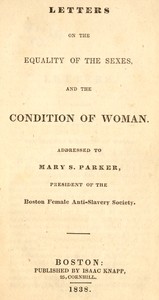
Read on Project GutenbergSarah Grimké opens her first letter with a bold claim: she will argue for women's equality by relying solely on the Bible, rejecting what she calls the “perverted interpretation of Holy Writ.” Writing to Mary S. Parker, president of the Boston Female Anti-Slavery Society, Grimké insists that King James's translators were not inspired, so she will consult the original Hebrew and Greek. Her method is evident from the start: she quotes Genesis 1:26–27 to show that “male and female” were both created in God's image and given dominion together. This textual move sets the pattern for the entire collection—each letter takes up a scriptural passage or a social practice and subjects it to close, reasoned scrutiny.
A Bible-Based Argument for Equality
Grimké's first letter establishes her core interpretive principle: the Bible, properly understood, supports women's equality. She points out that the word “man” in Genesis is a generic term including both sexes, and that no difference in authority or status is intimated at creation. This argument recurs throughout the letters. In later excerpts, she tackles Pauline passages that have been used to restrict women, though the provided text does not include those specific letters. What is clear is that Grimké treats scripture as a living document that demands personal study. She writes, “I claim to judge for myself what is the meaning of the inspired writers,” a stance that aligns her with Protestant individualism while challenging the male clerical authority of her day.
Dress, Vanity, and Christian Duty
In Letter XI, Grimké turns to the subject of women's dress, arguing that elaborate adornment is incompatible with Christian humility. She draws a sharp analogy: if a minister mounted the pulpit with earrings and artificial flowers, it would be deemed inappropriate; therefore, the same standard should apply to all professing Christians. Grimké does not prescribe a specific dress code—she says each woman must “settle this on her knees before God”—but she insists that the Bible's condemnations of costly array are still binding. She cites Isaiah 3:16–26 and 1 Peter 3:3–4 to show that God has spoken clearly on the matter. The letter is notable for its direct address to women's daily choices, linking personal piety to broader social reform.
Legal Disabilities and Political Existence
Letter XII shifts from personal conduct to structural injustice. Grimké declares that laws enacted without women's participation “rob her of some of her essential rights.” She observes that woman has “no political existence” except the right to petition, and that in representative governments she is “only counted, like the slaves of the South, to swell the number of law-makers.” This comparison to slavery is deliberate and recurring. Grimké cites Professor Follen's essay on freedom to support her claim, though the excerpt cuts off before she develops the legal details. Even so, the letter establishes a clear framework: women are subject to laws they had no hand in making, and this condition is fundamentally unjust.
A Cumulative Case Across Letters
The letters are not isolated essays but a sustained argument that builds from creation theology to contemporary practice. Each letter is dated and addressed to a specific recipient, giving the collection the feel of an ongoing correspondence. Grimké moves fluidly between scriptural exegesis, social critique, and legal analysis, always returning to the principle that women and men are equally moral beings. The excerpts show her characteristic voice: direct, earnest, and unafraid to challenge prevailing customs. She writes as a Quaker, using “thee” and “thy,” and signs off “Thine in the bonds of womanhood,” a phrase that underscores her sense of solidarity with her readers.
Reading these letters in sequence reveals how Grimké weaves together theological argument, moral exhortation, and political analysis. She does not assume her readers agree with her; instead, she anticipates objections and answers them with scripture and logic. The letters reward attention to her method—how she selects texts, draws analogies, and builds from first principles. A first-time reader may find it useful to track the scriptural passages she cites and to note how each letter extends or reinforces the previous one. The result is a work that is both a personal testament and a public manifesto.
I keep thinking about how Sarah Grimké found her voice through letters, slowly building arguments from quiet conviction. It reminded me of something else I came across—how even the most public figures wrestle privately with what they believe. A Compilation of the Messages and Papers of the Presidents. Volume 8, part 3: Grover Cleveland, First Term — Story, Setting & Ideas feels like that same kind of patient weighing of words.
There are no reviews for this eBook.
There are no comments for this eBook.
Reader reflection
Take a moment to reflect on this book
Create a short personal record of your experience with this book.
Your progress
0
/
10
2
Did this book hold your interest?
3
Would you encourage someone else to read it?
4
How demanding did the text feel?
5
Do you expect to return to this book?
6
Did this book create an emotional response?
7
What did you think about the pace?
8
Would you like to discuss this book with someone?
9
In one sentence, what did you learn?
10