1

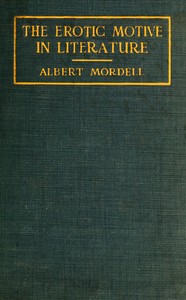
The Erotic Motive in Literature — Background and Themes
(0 User reviews)
1608
Project Gutenberg
2018
Not confirmed
Erotic literature -- History and criticism; Psychoanalysis and literature; Sex in literature
Readers of public-domain and historical texts
Project Gutenberg digital edition
en
Edition facts
Words
75,325
Reading time
328 min
Text sections
22
For The Erotic Motive in Literature — Background and Themes, the stored edition analysis reports 75,325 words, 5 hr 28 min estimated reading time, and 22 detected text sections.
The text analysis averages about 21.5 words per sentence, while the detected sections provide another way to judge how the source is divided.
Project Gutenberg metadata also associates the work with “Erotic literature -- History and criticism,” connecting these edition facts with the source record’s subject description.
Source:
Project Gutenberg record #56779
An early 20th-century application of Freudian psychoanalysis to literary criticism, examining how authors' unconscious erotic fantasies shape their works, with chapters on the Œdipus complex, sublimation, and sexual symbolism.
Read the complete public-domain text at its original source.
Read on Project GutenbergAlbert Mordell opens The Erotic Motive in Literature by declaring his intent to apply psychoanalytic methods to literary study, reading 'closely between the lines of an author's works' to uncover the unconscious. He argues that the unconscious is 'largely identical with the mental love fantasies in our present and past life,' making eroticism an unavoidable lens for serious criticism. The book, published in 1919, draws heavily on Freudian concepts such as the Œdipus complex, sublimation, and infantile sexuality, treating literary works as analogous to dreams—realized repressed wishes of the author.
The Unconscious as Literary Engine
Mordell's central claim is that every author reveals more than intended. He writes that 'works of the imagination open up to the reader hidden vistas in man's inner life just as dreams do.' The critic's task, then, is to trace a writer's books back to 'outward and inner events of his life' and to expose the unconscious emotions that guided the pen. This approach treats forgotten events and suppressed desires as active forces in literary production. Mordell insists that the principles he applies are 'fairly unimpeachable by science and experience,' though he offers no systematic defense of that assertion. Instead, he proceeds by analogy: as the psychoanalyst interprets dreams, the critic interprets literature, seeking 'ideal pictures inspired by past repressions.' The method is explicitly deterministic—the author's past dictates the text's hidden content.
Infantile Sexuality and Literary Origins
Chapter X, 'The Infantile Love Life of the Author and its Sublimations,' applies Freud's theory that children possess a sex life before puberty. Mordell argues that 'the nature of our later emotional and especially our love life is far more dependent upon the nature, aberrations, inhibitions, sublimations, developments and transformations of our infantile sex life than we ever in our wildest dreams imagined it to be.' He extends this to literary criticism: an author's work can be traced back to his infantile sex life, even when biographical details are scarce. For example, he suggests that homosexuality in literature—citing Shakespeare's Sonnets, Tennyson's In Memoriam, and Whitman's Calamus—originates in childhood bisexuality and the Œdipus complex. The boy who loses a strong father early and becomes over-attached to his mother may later identify with her and love boys like himself, a mechanism Mordell calls 'narcissism.'
Sexual Symbolism and the Atreus Legend
Mordell devotes a chapter to 'Sexual Symbolism in Literature' and another to 'Cannibalism: The Atreus Legend,' demonstrating his willingness to read myth and narrative through a Freudian lens. The Atreus story—featuring Thyestes eating his own children—is interpreted as an expression of repressed oral-sadistic fantasies. Mordell does not provide a close reading of the original texts in the excerpts, but his method is consistent: he treats plot elements as symbolic enactments of unconscious drives. The chapter on symbolism presumably catalogs objects and actions (e.g., towers, swords, journeys) as stand-ins for sexual organs or acts, a common practice in early psychoanalytic criticism. This approach risks reducing literature to a code, but Mordell frames it as a necessary corrective to conventional criticism that ignores the erotic substrate.
Psychoanalysis as Critical Tool
In the concluding chapter, Mordell argues that psychoanalysis can 'rid us of the evil influences of the past by making us aware of the unconscious disturbances.' He presents his method as both diagnostic and therapeutic: by exposing the erotic motives in literature, readers can purge themselves of repressed emotions. The book's structure—moving from theory to applied readings of Keats, Shelley, Poe, and Hearn—suggests that Mordell sees his work as a practical demonstration. Yet the excerpts reveal a tension: he claims his principles are 'well tested and infallible,' but the evidence he offers is often speculative. For instance, his analysis of Poe (Chapter XVI) is not excerpted here, but the table of contents indicates a psychoanalytic study that likely traces Poe's macabre themes to childhood trauma. Mordell's confidence in the method is unwavering, even as the science he cites was still contested in 1919.
Readers approaching The Erotic Motive in Literature should expect a polemical work that applies Freudian orthodoxy with little qualification. Mordell's readings are provocative but often rely on assertion rather than close textual evidence. The book is best understood as a historical document of early psychoanalytic criticism, revealing both the ambition and the limitations of applying clinical concepts to literary analysis. Those interested in the intersection of psychology and literature will find a clear, if dogmatic, statement of a once-influential approach.
Sometimes I think of that old Freudian study, how it traces hidden desires beneath the surface of words, and it reminds me of another kind of pursuit—finding truth within polite argument. Both whisper of what lies beneath the text, a quiet kinship of depth. The provincial letters of Blaise Pascal — Inside the Classic holds its own gentle fire, a different sort of passion, but no less real for being concealed airs.
There are no reviews for this eBook.
There are no comments for this eBook.
Reader reflection
Take a moment to reflect on this book
Create a short personal record of your experience with this book.
Your progress
0
/
10
2
What was your overall reaction to the book?
3
Would you encourage someone else to read it?
4
Did the language feel accessible?
5
Did the book deliver what you hoped for?
6
How original did the book feel?
7
Would a second reading be valuable?
8
Did you relate to its people, ideas, or situations?
9
Which lesson or insight stayed with you?
10