1

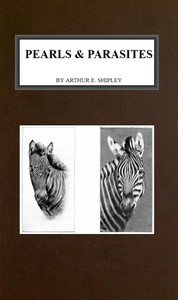
Pearls & Parasites — Reading Companion
(0 User reviews)
801
Project Gutenberg
2016
Not confirmed
Zoology; University of Cambridge; Marine animals; Pasteur, Louis, 1822-1895; Pearls; Fisheries -- Great Britain; Zebras; Malaria; Flies as carriers of disease
Readers of public-domain and historical texts
Project Gutenberg digital edition
en
Edition facts
Words
75,771
Reading time
330 min
Text sections
12
The source record for Pearls & Parasites — Reading Companion measures this digital text at 75,771 words, 5 hr 30 min estimated reading time, and 12 detected text sections.
The text analysis averages about 25.6 words per sentence, while the detected sections provide another way to judge how the source is divided.
Project Gutenberg metadata also associates the work with “Zoology,” connecting these edition facts with the source record’s subject description.
Source:
Project Gutenberg record #52580
A collection of essays on economic zoology by Cambridge zoologist Arthur Shipley, covering pearls, sea fisheries, zebra hybrids, Pasteur's anthrax research, malaria, and flies as disease carriers, with a detailed account of Cambridge University finances.
Read the complete public-domain text at its original source.
Read on Project GutenbergArthur E. Shipley’s Pearls & Parasites (1908) is a collection of essays that originally appeared in the Quarterly Review and other periodicals. Despite its title, the book ranges far beyond pearls and parasites: it includes studies of deep-sea exploration, British fisheries, zebra–horse hybrids, Louis Pasteur’s work on anthrax and chicken cholera, malaria, the role of flies in spreading disease, and a detailed analysis of Cambridge University’s finances. Shipley, a Cambridge zoologist, writes with a clear, factual style, often citing specific statistics—such as a 50% annual death rate from anthrax in some French sheep flocks—and describing experiments in precise, step-by-step prose. The essays are linked by a concern with how biological knowledge can be applied to practical problems, from pearl fishing to public health.
From Pearls to Pasteur: The Range of Topics
The catalog subjects list zoology, Cambridge University, marine animals, Pasteur, pearls, fisheries, zebras, malaria, and flies—and the excerpts confirm that each of these appears. However, the book is not a unified treatise but a set of separate essays, each self-contained. The essay on Pasteur, for example, focuses narrowly on his anthrax and chicken-cholera experiments, describing how an accidental inoculation with an old culture led to the discovery of attenuated viruses. Shipley notes that Pasteur’s explanation (oxygenation) was later shown to be wrong, but he credits him with originating methods for artificial immunity. The essay on zebras and hybrids is explicitly described as “pre-Mendelian,” written before the rediscovery of Mendel’s work. This variety means the book offers multiple entry points: a reader interested in medical history can jump to the Pasteur chapter, while a marine biologist might start with “The Depths of the Sea.”
Evidence and Numbers: Shipley’s Use of Data
Shipley frequently supports his arguments with specific figures. In the anthrax section, he reports that the disease killed 20% of sheep in La Beauce, 10–15% in Auvergne, and over 56,000 deaths in three years in Novgorod. He also describes a controlled experiment: of fifty sheep, half were inoculated and half were not; after infection, the uninoculated died of “charbon” while the inoculated remained healthy. This quantitative approach extends to the Cambridge essay, where he acknowledges the help of H. A. Roberts in navigating “the intricate mazes of the University accounts.” The excerpts do not reveal the conclusions of that essay, but the method is consistent: Shipley prefers concrete data over generalities. Readers should expect tables, percentages, and experimental details throughout.
The Limits of the Excerpts: What Remains Unknown
The excerpts cover only a portion of the book—the preface, contents, and part of the Pasteur chapter. The full text includes essays on “The Depths of the Sea,” “British Sea-Fisheries,” “Malaria,” “The Infinite Torment of Flies,” and “The Danger of Flies,” none of which are excerpted here. The preface indicates that the fly essay was originally an address to the British Association in Pretoria (1905), and the Cambridge essay is the only one not on economic zoology. The excerpts do not show Shipley’s treatment of pearls, despite the title, nor do they reveal how he connects the diverse topics. The catalog subject “University of Cambridge” is represented only by a single essay, whose contents are unknown. Readers should not assume that the book is a coherent whole; it is a collection, and each essay can be read independently.
Shipley’s essays reward readers who appreciate detailed, evidence-based writing on applied biology. The excerpts show a writer who values precision—whether describing the temperature sensitivity of Bacillus anthracis or the financial structure of a university. Because the book is a collection, readers may wish to begin with the topic that most interests them, using the table of contents as a guide. The preface also notes that the zebra essay is “pre-Mendelian,” so those seeking modern genetics should consult later sources. Overall, Pearls & Parasites offers a snapshot of early 20th-century zoological knowledge, framed by a Cambridge don’s practical concerns.
I found myself drifting back to Pearls & Parasites the other day, not for its oysters or flies, but for its patient accounting of Cambridge’s ledgers—turf, books, gowns. That quiet, stubborn attention to practical roots reminded me of a different voice, one from a Pennsylvania farm, gently itemizing rights and duties in a colonial twilight. Both felt like home economies, written with a scholar’s calm. Letters from a Farmer in Pennsylvania, to the Inhabitants of the British Colonies — Reading Companion carries that same unhurried warmth.
There are no reviews for this eBook.
There are no comments for this eBook.
Reader reflection
What was your reading experience?
Capture what you thought, learned, and would like to remember.
Your progress
0
/
10
2
Was reading this book enjoyable?
3
Would you encourage someone else to read it?
4
What was the reading difficulty like?
5
How clear did the writing feel?
6
Did the book give you something worth debating?
7
Was the book moving at the right speed?
8
Is this a title worth rereading?
9
Which lesson or insight stayed with you?
10