1

Letters from a Farmer in Pennsylvania, to the Inhabitants of the British Colonies — Reading Companion
(0 User reviews)
663
Project Gutenberg
2014
Not confirmed
Great Britain -- Colonies -- America -- Early works to 1800; United States -- History -- Revolution, 1775-1783 -- Causes; Finance -- Great Britain -- Colonies
Readers of public-domain and historical texts
Project Gutenberg digital edition
en
Edition facts
Words
49,276
Reading time
215 min
Text sections
7
Letters from a Farmer in Pennsylvania, to the Inhabitants of the British Colonies — Reading Companion can be approached with a clearer sense of reading commitment from its source measurements: 49,276 words, 3 hr 35 min estimated reading time, and 7 detected text sections.
The text analysis averages about 27.9 words per sentence, while the detected sections provide another way to judge how the source is divided.
Project Gutenberg metadata also associates the work with “Great Britain -- Colonies -- America -- Early works to 1800,” connecting these edition facts with the source record’s subject description.
Source:
Project Gutenberg record #47111
John Dickinson's 1767-1768 letters, published serially in the Pennsylvania Chronicle, use a farmer persona to argue against British taxation. The work's structure—twelve letters moving from specific acts to broader constitutional principles—and recurring images of agriculture, law, and colonial unity shape its persuasive strategy.
Read the complete public-domain text at its original source.
Read on Project GutenbergJohn Dickinson's Letters from a Farmer in Pennsylvania first appeared in the Pennsylvania Chronicle between November 1767 and February 1768, twelve weekly installments that were quickly reprinted across colonial newspapers. The work adopts a deliberate persona—a modest farmer—to frame its constitutional arguments, a rhetorical choice that shapes both its tone and structure. Dickinson moves from the specific provisions of the Townshend Acts to broader questions of parliamentary authority, using each letter to build a cumulative case. The letters are not isolated essays but a linked sequence, with recurring motifs of agricultural labor, legal precedent, and colonial interdependence. This structure mirrors the incremental nature of the crisis itself, as Dickinson responds to each new measure with measured analysis.
The Farmer’s Persona as Structural Device
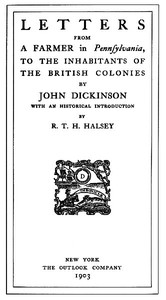
The title page presents the author as “The Patriotic American Farmer,” and the letters consistently maintain this voice. Dickinson writes as a plain-speaking cultivator, not a lawyer or politician, though his arguments are steeped in legal reasoning. This persona allows him to frame colonial rights as matters of common sense and natural justice, accessible to any reader. The farmer’s perspective also grounds abstract constitutional debates in concrete imagery: taxes are described as burdens on land, and the colonies are likened to a household whose economy must be managed prudently. By sustaining this voice across all twelve letters, Dickinson creates a consistent ethical appeal—the farmer is trustworthy, practical, and disinterested. The persona also structures the argument’s progression: each letter begins with a reference to the farmer’s rural setting or recent news, then moves to legal analysis, and closes with an appeal to unity. This pattern gives the series a rhythmic, almost epistolary intimacy.
Recurring Images of Agriculture and Economy
Throughout the letters, Dickinson returns to agricultural metaphors to explain economic policy. He describes taxes as “drains” on colonial resources, and the colonies as fields that must be cultivated carefully. In one passage, he warns that the new duties will “impoverish” the land, making it less productive for future generations. The farmer’s labor becomes a symbol of honest industry, contrasted with the “artifice” of parliamentary schemes. Dickinson also uses the image of a household budget to argue against taxation without representation: a farmer would not allow a stranger to decide how to spend his family’s money. These recurring images tie the abstract concept of liberty to tangible, everyday experience. They also reinforce the structural movement from local to global—the farmer’s field stands for the entire colonial economy, and his prudent management models the kind of governance the colonies seek. The metaphors are not decorative but functional, making complex fiscal arguments vivid and memorable.
Movement from Specific Grievances to Constitutional Principles
The letters follow a clear trajectory: early letters examine the Townshend Acts in detail—duties on glass, lead, paint, tea—while later letters expand to consider the constitutional implications. Dickinson carefully distinguishes between external trade regulations and internal taxes, a distinction central to his argument. In Letter II, he focuses on the act’s provision that revenue be used for a civil list, calling it “more dreadful than the Stamp-act” because it threatens colonial self-governance. By Letter XII, he has moved to a general defense of colonial rights, invoking the principle that “taxation without consent is slavery.” This progression is not linear but cumulative; each letter builds on the previous one, referencing earlier points and anticipating objections. The structure mirrors the unfolding political crisis, as Dickinson responds to new developments and refines his position. The reader is led step by step from a specific complaint to a sweeping constitutional claim, making the argument feel inevitable.
The Role of Colonial Unity in the Letters’ Rhetoric
Dickinson repeatedly calls for unity among the colonies, a theme that structures the later letters. He argues that the fate of one colony is the fate of all, and that division will only invite further encroachments. This appeal is not merely emotional; it is grounded in the legal argument that the colonies share a common constitutional status. Dickinson uses the image of a chain—if one link breaks, the whole is weakened—to illustrate interdependence. He also warns against the danger of “separate interests” and urges coordinated resistance through petitions and non-importation agreements. The letters themselves were a unifying force, reprinted from New England to the South, and Dickinson’s rhetoric anticipates the collective action that would later characterize the Continental Congress. The structure of the series—twelve letters, each reinforcing the same core message—mirrors the steady, patient work of building a coalition. The farmer’s voice, speaking from Pennsylvania to the entire colonial audience, becomes a model of that unity.
Dickinson’s Letters reward attention to their serial structure and rhetorical design. Reading them in sequence reveals how the farmer’s persona, agricultural imagery, and constitutional reasoning work together to build a persuasive case. The letters are best approached not as a legal treatise but as a carefully crafted political performance, one that helped shape colonial opinion in the years before independence. Pay particular attention to how Dickinson shifts between specific grievances and general principles, and how he uses repetition to drive his points home.
Leafing through Dickinson's patient letters, I kept thinking of how his farmer’s calm unraveled into principle, one furrow at a time. It reminded me of a dusty anthology I once borrowed, where critics argued with equal seriousness about books now forgotten. There’s something tender about that earnestness. Famous Reviews, Selected and Edited with Introductory Notes by R. Brimley Johnson — Reading Companion holds that same quiet faith in words changing minds.
There are no reviews for this eBook.
There are no comments for this eBook.
Reader reflection
Record your reading impressions
A brief reflection can help important ideas stay with you longer.
Your progress
0
/
10
2
How much did you enjoy the reading experience?
3
How likely are you to recommend this book?
4
Did the language feel accessible?
5
Did the book offer a fresh perspective?
6
What was the strongest part of the book?
7
Would you start a conversation about this book?
8
How strongly did the book affect you emotionally?
9
Which lesson or insight stayed with you?
10