1

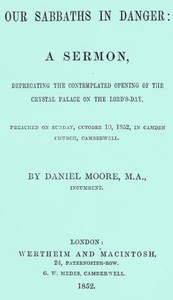
Our Sabbaths in Danger A Sermon, deprecating the contemplated opening of the Crystal Palace on the Lord's-Day — Edition Insights
(0 User reviews)
1728
Project Gutenberg
2020
Not confirmed
Sunday; Church of England -- Sermons -- 19th century; Crystal Palace (Sydenham, London, England); Sunday legislation -- Great Britain
Readers of public-domain and historical texts
Project Gutenberg digital edition
en
Edition facts
Words
10,813
Reading time
48 min
Text sections
2
Our Sabbaths in Danger A Sermon, deprecating the contemplated opening of the Crystal Palace on the Lord's-Day — Edition Insights can be approached with a clearer sense of reading commitment from its source measurements: 10,813 words, 48 min estimated reading time, and 2 detected text sections.
The text analysis averages about 31.5 words per sentence, while the detected sections provide another way to judge how the source is divided.
Project Gutenberg metadata also associates the work with “Sunday,” connecting these edition facts with the source record’s subject description.
Source:
Project Gutenberg record #62221
A sermon preached in 1852 by Daniel Moore against opening the Crystal Palace on Sundays, using biblical exegesis and moral argument to oppose Sabbath desecration, with specific references to contemporary social conditions.
Read the complete public-domain text at its original source.
Read on Project GutenbergDaniel Moore's 1852 sermon, preached at Camden Church, Camberwell, directly addresses a specific legislative proposal: opening the Crystal Palace on Sundays. The text is not a general treatise on Sabbath observance but a targeted polemic, grounded in a close reading of Mark 2:27. Moore argues that while the Sabbath is made for man, its sanctity is not arbitrary but rooted in divine will for human benefit. He distinguishes between moral ends and outward ordinances, warning against both hypocrisy and presumption. The sermon's occasion—a Sunday in October 1852—gives it an urgent, occasional character, and Moore's rhetoric is shaped by the political and social context of the Crystal Palace as a symbol of progress and entertainment.
Biblical Argument and the Distinction Between Ends and Means
Moore opens with a careful exegesis of Mark 2:27, emphasizing that the Sabbath was made for man, not man for the Sabbath. He uses this to counter two errors: over-strictness and disregard. The sermon's logic hinges on a distinction between moral ends—obeying God, resisting evil, striving for conformity to the divine image—and outward ordinances like holy times and solemn assemblies. These, Moore argues, are subsidiary means, not final objects. This framework allows him to argue that the Sabbath's observance must align with its purpose, not rigid ceremonialism. He warns against both the hypocrisy of exaggerated importance and the presumption of ignoring its sanctity. The argument is tightly tied to the biblical text, with Moore positioning himself as a defender of a balanced, principled interpretation.
Moral and Social Consequences of Sabbath Desecration
Moore shifts to practical arguments, citing the demoralizing influence of opening the Crystal Palace. He quotes Burke's sentiment that vice loses half its danger by losing its grossness, then refutes it: sin is sin, masked or not. He contrasts the current Sabbath-breaker, who steals away to low taverns, with a future offender who would sin under Royal authority, parroting infidel pretenses. Moore provides specific data: from a pleasure garden in a country town, 3,000 people consumed nearly 600 gallons of malt liquor on a Sunday evening. He calculates that this implies one quart per adult, a detail he calls painful but necessary. This empirical turn grounds his moral argument in observable social conditions, challenging the claim that such venues would reduce vice.
Rhetorical Strategies and Audience Address
Moore's sermon is marked by direct address to his congregation—'brethren'—and vivid imagery. He warns that God might 'curse them not in a granted desire' and invokes the millstone metaphor from the Gospels. His language is forceful: he speaks of 'thoughtless speculators' and 'the fearful responsibility of having destroyed thousands of undying souls.' The sermon also uses rhetorical questions and contrasts, such as the 'whited sepulchre' versus 'dead men's bones.' Moore appeals to national piety and honour, framing the issue as a test of religious decency. His tone is urgent, and he does not shy from graphic depictions of moral danger, aiming to move his listeners to action against the proposed opening.
Moore's sermon offers a window into mid-Victorian religious and social anxieties, where commercial progress and Sabbath observance clashed. Readers should note how the sermon blends scriptural interpretation with contemporary data, and how its occasional nature—preached on a specific date—shapes its arguments. The text is valuable for understanding the rhetorical strategies of 19th-century Anglican preaching on public morality, and the specific controversy over the Crystal Palace's Sunday opening provides a concrete historical context.
That 1852 sermon still feels oddly close, that worry about what we lose when sacred rest becomes commerce. There’s a similar ache in Ten Essays on Zionism and Judaism — Inside the Classic, a longing for something older than the arguments. I remember finishing it and just sitting there, quiet, thinking about how we keep guarding what matters.
There are no reviews for this eBook.
There are no comments for this eBook.
Reader reflection
What was your reading experience?
Capture what you thought, learned, and would like to remember.
Your progress
0
/
10
2
Did this book hold your interest?
3
How likely are you to recommend this book?
4
Did the language feel accessible?
5
Which aspect of the book did you value most?
6
How personally connected did you feel to the book?
7
How useful were the ideas in this book?
8
Was the book easy to understand?
9
What is the main idea you are taking away?
10