1

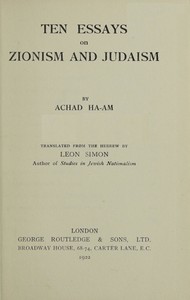
Ten Essays on Zionism and Judaism — Inside the Classic
(0 User reviews)
188
Project Gutenberg
2022
Not confirmed
Jews -- Restoration; Zionism; Judaism
Readers of public-domain and historical texts
Project Gutenberg digital edition
en
Edition facts
Words
86,629
Reading time
377 min
Text sections
17
Before opening Ten Essays on Zionism and Judaism — Inside the Classic, the edition data offers a quick orientation: 86,629 words, 6 hr 17 min estimated reading time, and 17 detected text sections.
The text analysis averages about 30.3 words per sentence, while the detected sections provide another way to judge how the source is divided.
Project Gutenberg metadata also associates the work with “Jews -- Restoration,” connecting these edition facts with the source record’s subject description.
Source:
Project Gutenberg record #67667
A collection of eight polemical essays and two broader reflections by Ahad Ha'am, translated by Leon Simon, tracing the evolution of Zionist thought through internal debates on political versus practical Zionism, the role of anti-Semitism, and the concept of a spiritual centre.
Read the complete public-domain text at its original source.
Read on Project GutenbergAhad Ha'am's essays, written between 1889 and 1912, are not a unified manifesto but a series of interventions in an ongoing argument. The translator's introduction notes that eight of the ten pieces were deliberately chosen for their polemical character, addressing the modern Jewish national movement from the perspective of a staunch pillar and unsparing critic. The collection opens with Ha'am's earliest essay, from the years before the term 'Zionism' was coined, and closes with his assessment of practical results in Palestine up to 1911.
The essays are marked by a distinctive rhetorical strategy: Ha'am frequently dissects the language and assumptions of his opponents, exposing contradictions between stated goals and actual methods. He is particularly attentive to the way 'Zionist tradition' becomes a fixed phrase that can obscure shifting meanings.
The Rhetoric of Division: 'Politicals' vs. 'Practicals'
Ha'am structures his critique around a recurring binary: the 'politicals' who seek diplomatic recognition and mass immigration, and the 'practicals' who focus on incremental settlement and cultural work. In the excerpt from the essay on the First Zionist Congress, he describes the politicals as arriving 'with empty hands' and relying on 'trumpetings and loud alarums' that have lost their force. The practicals, by contrast, bring 'a complete programme of practical work in Palestine' but dare not articulate their true end—'a fixed centre for the spirit of Israel' rather than a home of refuge.
This division is not merely descriptive; Ha'am uses it to highlight a failure of honesty. The practicals, he writes, 'broke off abruptly, and did not complete their thought—for a very good reason.' The reason is that acknowledging their real aim would undermine the popular appeal of Zionism as a solution to persecution. Ha'am's own position emerges through this critique: he favours the practicals' methods but insists on clarity about ends.
Anti-Semitism as a Rhetorical Lever
Ha'am closely examines how Zionist speakers deploy anti-Semitism as a justification. He notes that at earlier Congresses, Max Nordau's speeches followed a predictable pattern: describe the perilous position of Jews worldwide, then conclude 'therefore, if you wish to be saved, join us.' At the Congress under discussion, however, Nordau 'changed his tune'—he described the evil and issued reproaches, but the 'therefore' was 'lacking almost entirely.'
This observation is typical of Ha'am's method: he attends to the structure of an argument, not just its content. The missing 'therefore' signals a crisis in political Zionism's logic. Ha'am also remarks that speakers who openly opposed 'Zionism based on anti-Semitism' were not shouted down, as they would have been in earlier years. The shift indicates a movement in transition, where the old rhetorical certainties no longer hold.
The Unspoken End: A Spiritual Centre
Central to Ha'am's critique is the distinction between a 'home of refuge' and a 'fixed centre for the spirit of Israel.' The former, he argues, is the goal assumed by the 'Zionist tradition' and the basis of popular support. The latter is what practical work in Palestine—buying land, founding schools, establishing a college—actually serves. But this goal is rarely stated openly, because it lacks the emotional appeal of promised redemption from persecution.
Ha'am's language here is precise: the practicals are 'ruled unconsciously by the instinct of national self-preservation.' They work toward an end they cannot name. The phrase 'a fixed centre for the spirit of Israel' appears as a quiet alternative to the more grandiose 'redemption of the nation.' Ha'am does not reject the practical work; he insists that its true purpose be acknowledged. The essays thus function as a call for intellectual honesty within the movement.
Temporal Framing and the Pace of Change
Ha'am pays careful attention to how Zionists imagine time. He recalls the opening speech of the first Congress, which estimated that colonising work would bring the exiled people back to Palestine 'in nine hundred years.' This figure is not presented as a prediction but as a revealing measure of the gap between rhetoric and reality. The politicals, he suggests, have lost faith in quick results but cannot admit it; they fall back on 'the hope of a vague future.'
The practicals, by contrast, work in the present, but their incremental achievements—'the occasional purchase of a small piece of land, the foundation of a tiny colony with infinite pains'—seem trivial measured against the traditional goal. Ha'am's own temporal perspective is more patient: he sees the work in Palestine as building slowly toward a spiritual centre, not a political state. The essays repeatedly return to the tension between immediate needs and long-term cultural transformation.
Readers approaching these essays should expect not a systematic treatise but a series of forensic engagements with the Zionist movement's own arguments. Ha'am's value lies in his refusal to accept comfortable fictions, whether about the pace of change or the nature of the goal. The translator's note that Ha'am fell silent after 1911 due to war and ill-health adds a poignant frame: these essays represent a sustained effort to clarify what Zionism could mean, at a moment when the movement was still defining itself.
Reading Ahad Ha'am’s insistence on a spiritual centre, I recalled sitting in my grandfather’s study, him explaining how our people’s survival was never about land alone but about shared meaning. That same quiet weight returned in The Interpreters of Genesis and the Interpreters of Nature Essay #4 from "Science and Hebrew Tradition" — Context and Discussion, where old stories and new sciences somehow face each other without shouting. Both books left me holding a single, still question about what we carry forward.
There are no reviews for this eBook.
There are no comments for this eBook.
Reader reflection
Record your reading impressions
A brief reflection can help important ideas stay with you longer.
Your progress
0
/
10
2
Was reading this book enjoyable?
3
How likely are you to recommend this book?
4
What was the reading difficulty like?
5
Did the book deliver what you hoped for?
6
Would a second reading be valuable?
7
Would you like to discuss this book with someone?
8
How did the pace of the book feel?
9
Which lesson or insight stayed with you?
10