1

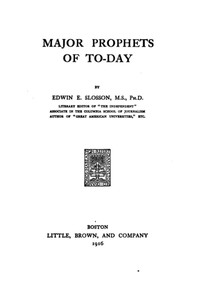
Major Prophets of To-Day — Reading Companion
(0 User reviews)
1697
Project Gutenberg
2015
Not confirmed
Bergson, Henri, 1859-1941; Poincaré, Henri, 1854-1912; Maeterlinck, Maurice, 1862-1949; Metchnikoff, Elie, 1845-1916; Ostwald, Wilhelm, 1853-1932; Haeckel, Ernst, 1834-1919
Readers of public-domain and historical texts
Project Gutenberg digital edition
en
Edition facts
Words
71,740
Reading time
312 min
Text sections
7
The catalog record for Major Prophets of To-Day — Reading Companion provides practical reading context through 71,740 words, 5 hr 12 min estimated reading time, and 7 detected text sections.
The text analysis averages about 24.9 words per sentence, while the detected sections provide another way to judge how the source is divided.
Project Gutenberg metadata also associates the work with “Bergson, Henri, 1859-1941,” connecting these edition facts with the source record’s subject description.
Source:
Project Gutenberg record #48180
Edwin E. Slosson profiles six European thinkers—Bergson, Poincaré, Maeterlinck, Metchnikoff, Ostwald, Haeckel—based on personal visits in 1910. The book introduces their ideas for general readers, emphasizing direct acquaintance over secondhand accounts.
Read the complete public-domain text at its original source.
Read on Project GutenbergEdwin E. Slosson’s Major Prophets of To-Day (1916) presents itself as a series of introductions, not a substitute for the works themselves. Slosson visited each of the six figures in their homes during the summer of 1910, aiming to confirm they were “flesh and blood, instead of paper and ink.” The book’s preface frames this as a response to the difficulty of grasping philosophy at second hand, “after multiple translation through minds sometimes alien or hostile.” The resulting chapters blend biographical sketch, intellectual summary, and travelogue, with Slosson acting as a curious intermediary rather than a detached critic.
The Interview as Method
Slosson’s approach is deliberately personal. He describes meeting Élie Metchnikoff at the Pasteur Institute, armed with a letter from Jacques Loeb, and finding a man with “a short figure and a large head, with a bushy gray beard, but hair that is still dark.” Such physical details are not incidental; they serve Slosson’s stated goal of humanizing abstract thought. The visit to Metchnikoff’s laboratory becomes a tour of a “zoölogical garden,” where animals are kept for disease research—parrots, bats, chimpanzees—each tied to a specific scientific question. Slosson notes that Metchnikoff, like Agassiz, has “no time to get rich,” and that he donated his Nobel prize money to longevity research. These observations ground the philosopher’s ideas in a lived context, though Slosson admits he did not expect to gain “deeper insight into their mental processes” from the meetings.
The Catalog Subjects and the Actual Content
The Project Gutenberg record lists subjects such as Bergson, Poincaré, and Haeckel, but the excerpts show Slosson’s treatment is uneven. The Metchnikoff chapter, for instance, devotes considerable space to the Pasteur Institute’s architecture and history—the “bronze statue of Jupile,” the tomb of Pasteur, the bequest of the banker Osiris—before turning to Metchnikoff’s own work. Slosson’s interest in the setting sometimes overshadows the philosophy. He mentions Metchnikoff’s “Optimistic Studies” and his wife’s experiments, but the excerpt does not detail the core of Metchnikoff’s theories on aging or intestinal flora. Readers expecting a systematic exposition of each thinker’s system may find instead a journalist’s impression, filtered through Slosson’s own curiosity about the material conditions of intellectual life.
The Limits of the Excerpts
The available text covers only the preface and part of the Metchnikoff chapter. From this, it is impossible to assess how Slosson handled the other five figures—whether he gave equal space to Bergson’s élan vital or Haeckel’s monism, or whether he maintained the same blend of travel writing and summary. The preface suggests a consistent method: each chapter ends with directions for further reading, and the book is explicitly designed for “the general reader.” But without the full chapters, we cannot verify whether Slosson’s introductions achieve their aim of letting readers “drink at the source.” The catalog’s secondary topic “philosophy-ethics” may also be misleading; the Metchnikoff excerpt touches on ethics only obliquely, through the scientist’s personal austerity and dedication to prolonging life.
Slosson’s book is best approached as a period piece of intellectual journalism, not a definitive guide. Readers interested in Bergson, Poincaré, or Haeckel should treat these chapters as starting points, supplemented by the original works Slosson recommends. The value lies in the glimpses of early twentieth-century scientific culture—the Pasteur Institute’s menagerie, the Nobel prize’s impact, the transatlantic exchange of ideas—rather than in deep philosophical analysis.
Slosson’s visits to six busy minds remind me of the quiet patience he brought to each doorway. That same gentle stepping aside, letting a person speak first, lives in his later catalog of strangers and their puzzling habits. There is a softness between the two, like recognizing an old friend’s handwriting. See, for instance, Pearls & Parasites — Reading Companion, where wonder never hurries.
There are no reviews for this eBook.
There are no comments for this eBook.
Reader reflection
Before you leave, reflect on the book
Use these questions to collect your thoughts before moving on.
Your progress
0
/
10
2
How did the book work for you overall?
3
Is this a title you would suggest to others?
4
How much effort did this book require?
5
Did the story or argument move comfortably?
6
How distinctive were its ideas or approach?
7
Would this book work well in a reading group?
8
What was the strongest part of the book?
9
What did this book teach you most?
10