1

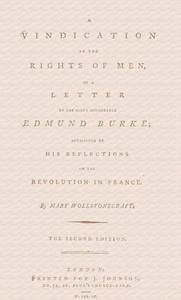
A vindication of the rights of men, in a letter to the Right Honourable Edmund Burke; occasioned by his Reflections on the Revolution in France — Edition Insights
(0 User reviews)
2115
Project Gutenberg
2020
Not confirmed
France -- History -- Revolution, 1789-1799 -- Causes; Liberty; Burke, Edmund, 1729-1797. Reflections on the revolution in France; Human rights
Readers of public-domain and historical texts
Project Gutenberg digital edition
en
Edition facts
Words
28,091
Reading time
123 min
Text sections
5
For A vindication of the rights of men, in a letter to the Right Honourable Edmund Burke; occasioned by his Reflections on the Revolution in France — Edition Insights, the stored edition analysis reports 28,091 words, 2 hr 3 min estimated reading time, and 5 detected text sections.
The text analysis averages about 32.6 words per sentence, while the detected sections provide another way to judge how the source is divided.
Project Gutenberg metadata also associates the work with “France -- History -- Revolution, 1789-1799 -- Causes,” connecting these edition facts with the source record’s subject description.
Source:
Project Gutenberg record #62757
Mary Wollstonecraft's direct rebuttal to Edmund Burke's Reflections on the Revolution in France, arguing for natural rights and reason over inherited privilege. Written as a letter, it exposes contradictions in Burke's defense of tradition and aristocracy, using sharp rhetoric and moral philosophy.
Read the complete public-domain text at its original source.
Read on Project GutenbergMary Wollstonecraft opens her letter to Edmund Burke with a deliberate refusal of courtly insincerity, declaring she has not learned to 'twist my periods' or disguise her sentiments. This directness sets the tone for a polemic that treats Burke's Reflections on the Revolution in France not as a measured argument but as a collection of 'sophistical arguments' dressed in 'natural feelings and common sense.' Wollstonecraft frames her response as a vindication of 'the rights of men and the liberty of reason,' opposing what she sees as Burke's defense of hereditary privilege and irrational tradition.
Rhetoric of Indignation and Moral Clarity
Wollstonecraft's prose is shaped by a moral urgency that rejects the polished equivocation she associates with Burke. She writes that 'truth, in morals, has ever appeared to me the essence of the sublime; and, in taste, simplicity the only criterion of the beautiful.' This aesthetic principle underlies her attack on Burke's style, which she implies obscures injustice with eloquence. Her own sentences are declarative and confrontational, as when she asserts, 'I war not with an individual when I contend for the rights of men and the liberty of reason.' The letter form allows her to address Burke directly, turning his own rhetorical strategies against him by insisting on plain speaking as a moral duty.
The Corruption of Clergy and Aristocratic Dependence
Wollstonecraft targets the clergy as a prime example of how institutional hierarchy corrupts character. She argues that 'servility to superiors, and tyranny to inferiors' arise naturally from associating with the nobility, and that 'among unequals there can be no society.' The clergy, she claims, become 'courtly parasites' who bend their spirits to patrons rather than reason. This critique extends to the historical origins of church property, which she attributes to 'the rapacity of the only men who exercised their reason, the priests,' who exploited fears of purgatory for financial gain. By linking moral degradation to social structure, Wollstonecraft challenges Burke's reverence for established institutions.
Reason, Religion, and the Human Heart
Despite her attack on institutional religion, Wollstonecraft affirms a personal, rational faith. She asks, 'What else can fill the aching void in the heart, that human pleasures, human friendships can never fill?' and answers with a 'profound reverence for the model of all perfection.' This religious feeling is tied to reason and moral autonomy, not dogma. She contrasts genuine piety with the 'separation of religion from morality' she attributes to priestly manipulation. The passage moves from social critique to an almost lyrical meditation on trust in a 'mighty Spirit' that calms the troubled heart, suggesting that true religion supports the dignity and equality she champions throughout the letter.
Wollstonecraft's letter is best read as a performance of reasoned indignation, where every rhetorical choice serves a moral argument. Readers attentive to her shifts between direct accusation and philosophical reflection will see how she builds a case for natural rights not on abstract theory alone but on a vision of human dignity that demands both social reform and personal integrity. The letter remains a striking example of political writing that refuses to separate style from substance.
Years ago, I shelved Mary Wollstonecraft’s fierce little letter, her pen still warm with indignation. Beside it now rests Major Prophets of To-Day — Reading Companion, and I find myself thinking how both share a certain lone conviction—voices that spoke clearly into their own noise, waiting quietly for a patient reader’s ear.
There are no reviews for this eBook.
There are no comments for this eBook.
Reader reflection
Before you leave, reflect on the book
Use these questions to collect your thoughts before moving on.
Your progress
0
/
10
2
How did the book work for you overall?
3
Would you recommend this book to another reader?
4
What was the reading difficulty like?
5
What was the strongest part of the book?
6
What was its emotional impact?
7
Would you like to discuss this book with someone?
8
Was the book what you thought it would be?
9
What is the main idea you are taking away?
10