1

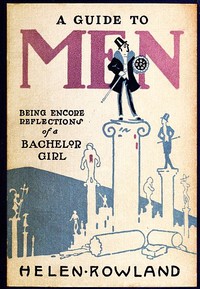
A Guide to Men: Being Encore Reflections of a Bachelor Girl — Themes and Context
(0 User reviews)
310
Project Gutenberg
2009
Not confirmed
Women -- Humor; Men -- Humor; Marriage -- Humor; Man-woman relationships -- Humor
Readers of public-domain and historical texts
Project Gutenberg digital edition
en
Edition facts
Words
17,668
Reading time
77 min
Text sections
4
This digital edition of A Guide to Men: Being Encore Reflections of a Bachelor Girl — Themes and Context is described by source-level measurements including 17,668 words, 1 hr 17 min estimated reading time, and 4 detected text sections.
The text analysis averages about 23.1 words per sentence, while the detected sections provide another way to judge how the source is divided.
Project Gutenberg metadata also associates the work with “Women -- Humor,” connecting these edition facts with the source record’s subject description.
Source:
Project Gutenberg record #30630
Helen Rowland's 1922 collection of epigrams and aphorisms dissects courtship, marriage, and the bachelor girl's perspective through witty, cynical observations on men, women, and relationships.
Read the complete public-domain text at its original source.
Read on Project GutenbergHelen Rowland's A Guide to Men (1922) is structured as a sequence of short, titled sections—Overture, Refrain, Interludes, Variations—that mimic musical movements, a formal choice that frames her epigrams as performances. The table of contents lists headings like "Cymbals & Kettle-drums" and "Syncopations," reinforcing a playful, orchestrated rhythm. Rowland's voice is consistently aphoristic: she compresses observations into single, balanced sentences, often using antithesis or unexpected juxtaposition. For example, she writes that "Marriage is a discord that turns 'Love's Old Sweet Song' from a eulogy into an elegy," a line that relies on the contrast between musical harmony and marital reality. This structural and tonal consistency suggests a deliberate authorial persona—the bachelor girl as a detached, witty commentator.
Epigram as Structure
Rowland organizes her material into discrete, titled clusters, each functioning as a mini-essay built from a series of standalone epigrams. The sections are not narrative but thematic: "Bachelors," "Brides," "Widows," "Divorces." Within each, the epigrams accumulate without transition, creating a mosaic effect. For instance, in "Widows," she writes: "A widow is a fascinating being with the flavor of maturity, the spice of experience, the piquancy of novelty, the tang of practiced coquetry, and the halo of one man's approval." The sentence is a list of parallel phrases, each adding a layer of ironic praise. This repetitive, cataloguing style is typical: Rowland often piles up nouns or adjectives to build a composite portrait. The structure mirrors the way social types are constructed through clichés, which she then subverts with a cynical twist.
Recurring Images of Food and Commerce
A striking pattern in the excerpts is the use of food and marketplace metaphors. Men and women are compared to commodities: widows are "caviare and wine," girls are "milk and honey." Marriage is described as an "operation" or a "price," and widowhood as a "rebate." These images reduce romantic relationships to transactions or consumables, reinforcing the book's cynical tone. Rowland also uses domestic and bodily imagery: a man's soul "lies so close to his digestion" that a woman cannot tell whether to offer "a kiss, a meal, a dose of philosophy or a dyspepsia tablet." The recurring conflation of emotional and physical needs suggests that Rowland views human behavior through a lens of biological and economic determinism, a consistent thread across sections.
Movement Between Social Roles
The book's sequence moves through stages of a relationship lifecycle: from bachelorhood and true love to marriage, divorce, widowhood, and remarriage. Each section treats its subject as a distinct type with predictable behaviors. For example, "Bachelors" is followed by "True Love—How to know it," then "Blondes" and "Cymbals & Kettle-drums," suggesting a progression from single life to courtship to conflict. The interludes—"First Interlude," "Second Interlude," etc.—function as pauses or shifts in tempo, much like musical movements. This structure implies a cyclical view of relationships: the final section, "Curtain," closes the performance, but the content does not resolve into a conclusion. Instead, the book ends with a series of epigrams that reinforce the same ironic detachment, leaving the reader with no sense of progress or moral.
The Bachelor Girl's Consistent Persona
Throughout the excerpts, the narrator identifies herself as a "bachelor girl," a figure who observes men and marriage from the outside. Her tone is uniformly knowing and slightly superior, as in: "A man spends his boyhood struggling against an education, his youth struggling against matrimony and his middle-age struggling against embonpoint; but sooner or later he succumbs to all of them." The parallelism and the final verb "succumbs" imply a fatalistic view of male development. The narrator never expresses personal vulnerability or desire; she is a commentator, not a participant. This consistent persona gives the book a unified voice, but it also limits emotional range. The epigrams rarely deviate from this cool, analytical stance, which may be intentional—a performance of the bachelor girl's supposed freedom from romantic illusion.
Readers approaching A Guide to Men should attend to how Rowland uses repetition and variation: the same metaphors (food, music, commerce) reappear across sections, creating internal echoes. The book rewards browsing rather than linear reading; its structure invites dipping into any section. Because the excerpts are incomplete, the full range of Rowland's targets and her handling of the "bachelor girl" persona remain partially obscured. The epigrams are best appreciated as a sustained exercise in wit, not as a guide to actual relationships.
I remember shelving Helen Rowland’s witty barbs in 1922, her bachelor girl laughing at the eternal game. Yet beside her cynicism, I often think of an older, quieter voice—Sarah Grimké’s. Her plain plea for women’s souls feels like a seed beneath Rowland’s polished floor. Both knew the rules were rigged. Here is that gentle, earnest echo: Letters on the equality of the sexes, and the condition of woman — Text and Context.
There are no reviews for this eBook.
There are no comments for this eBook.
Reader reflection
How did this book work for you?
Your answers remain private and are stored only in this browser.
Your progress
0
/
10
2
How did the book work for you overall?
3
Would you recommend this book to another reader?
4
How demanding did the text feel?
5
How useful did the reading feel?
6
How would you describe its reading pace?
7
Would you read this book again?
8
Did any part of the book feel personally relevant?
9
In one sentence, what did you learn?
10