1

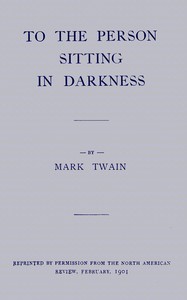
To the Person Sitting in Darkness — Background and Themes
(0 User reviews)
91
Project Gutenberg
2020
Not confirmed
South African War, 1899-1902; Philippines -- History -- Philippine American War, 1899-1902; China -- History -- Boxer Rebellion, 1899-1901; Imperialism
Readers of public-domain and historical texts
Project Gutenberg digital edition
en
Edition facts
Words
7,939
Reading time
35 min
Text sections
2
This digital edition of To the Person Sitting in Darkness — Background and Themes is described by source-level measurements including 7,939 words, 35 min estimated reading time, and 2 detected text sections.
The text analysis averages about 23.2 words per sentence, while the detected sections provide another way to judge how the source is divided.
Project Gutenberg metadata also associates the work with “South African War, 1899-1902,” connecting these edition facts with the source record’s subject description.
Source:
Project Gutenberg record #62636
Mark Twain's satirical essay dissects the rhetoric of imperialism by contrasting the advertised 'Blessings of Civilization' with the brutal realities of the Philippine-American War, the Boxer Rebellion, and the South African War, using sarcasm and fabricated justifications.
Read the complete public-domain text at its original source.
Read on Project GutenbergMark Twain opens To the Person Sitting in Darkness with a sardonic business metaphor: extending civilization to those 'sitting in darkness' is a trade that 'has paid well, on the whole.' He immediately establishes a cynical tone by describing the 'Blessings-of-Civilization Trust' as a 'Daisy'—a profitable enterprise that requires careful management. The essay's structure mimics a sales pitch, complete with a list of virtues (Love, Justice, Gentleness, etc.) that are 'strictly for Export,' while the actual product delivered is exploitation. This framing sets up the central irony: the gap between proclaimed ideals and imperial practice.
The Export Brand of Civilization
Twain's central conceit is that civilization comes in two brands: one for home consumption and one for export. The home brand includes genuine virtues, but the export version is 'merely an outside cover, gay and pretty and attractive,' inside which is 'the Actual Thing that the Customer Sitting in Darkness buys with his blood and tears.' This metaphor recurs throughout the essay, allowing Twain to dissect specific imperial actions. He cites the Philippine-American War, the Boxer Rebellion, and the South African War as case studies where the export brand was delivered. The essay's structure—alternating between ironic praise and damning evidence—mirrors the deceptive packaging he condemns.
Sarcasm as a Rhetorical Weapon
Twain's voice is relentlessly sarcastic. He advises readers to practice reading newspaper headlines 'with the right tang of lightness and gaiety' before presenting them to the 'Person Sitting in Darkness.' Headlines like 'REAL WAR AHEAD FOR FILIPINO REBELS!' and 'WILL SHOW NO MERCY!' are meant to be delivered with humorousness to 'modify their grim eloquence.' This technique exposes the absurdity of treating atrocities as public relations material. Twain also mocks the euphemism 'rebels' by parenthetically instructing to 'Mumble that funny word—don't let the Person catch it distinctly.' The sarcasm is not merely comic; it serves to highlight the deliberate obfuscation of imperial violence.
Embedded Evidence: The Soldier's Letter
Twain anchors his argument with a specific piece of evidence: a letter from an American soldier in the Philippines to his mother, published in Public Opinion of Decorah, Iowa. The soldier writes, 'We never left one alive. If one was wounded, we would run our bayonets through him.' Twain presents this quotation without immediate commentary, letting the stark language speak for itself. He then imagines the 'Person Sitting in Darkness' fainting at the confession that Americans 'massacre theirs' while Filipinos spare their wounded. This juxtaposition—the soldier's casual brutality versus the official rhetoric of benevolence—is the essay's most damning moment. Twain uses the letter to show that the truth is already public, yet ignored.
The Trinity of National Gods
In the essay's climax, Twain envisions a new American trinity: Washington holding 'the Sword of the Liberator,' Lincoln holding 'the Slave's Broken Chains,' and the 'Master of the Game' holding 'the Chains Repaired.' This blasphemous image completes the satire by equating imperial conquest with liberation. The 'Master of the Game'—likely President McKinley—is elevated to divine status, but his emblem is repaired chains, symbolizing re-enslavement. Twain's use of religious language throughout the essay (the 'Blessings-of-Civilization Trust,' 'Providence,' 'Trinity') reinforces the idea that imperialism has become a secular religion. The closing lines predict that this new trinity will sit 'age after age' in the people's sight, a chilling prophecy of enduring hypocrisy.
Readers should pay close attention to Twain's use of direct quotations from newspapers and soldiers' letters. These embedded texts are not decorative; they are the evidence that undercuts the official story. The essay's brevity—under 8,000 words—belies its density. Each paragraph builds the case that the 'Person Sitting in Darkness' is not a passive recipient but a witness to the gap between word and deed. Twain's irony is a tool for exposure, not mere humor.
Twain’s scathing anger in To the Person Sitting in Darkness has long reminded me of how we sometimes need noise to find silence. His righteous fury is the chattering stream; the quieter kinship lives in Rustic Sounds, and Other Studies in Literature and Natural History — Background and Themes, where the world’s ache softens into birdsong and old wood. Both, I think, are merely listening for the same honest truth.
There are no reviews for this eBook.
There are no comments for this eBook.
Reader reflection
Before you leave, reflect on the book
Use these questions to collect your thoughts before moving on.
Your progress
0
/
10
2
Was reading this book enjoyable?
3
Would you encourage someone else to read it?
4
How easy was the book to follow?
5
What did you think about the pace?
6
Did the book meet your expectations?
7
Would this book work well in a reading group?
8
Could you see yourself revisiting this book?
9
What changed or sharpened your thinking?
10