1

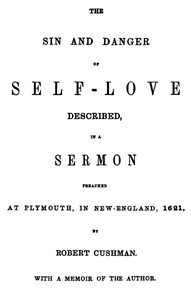
The Sin and Danger of Self-Love Described by a Sermon Preached At Plymouth, in New-England, 1621 — Story, Setting & Ideas
(0 User reviews)
977
Project Gutenberg
2013
Not confirmed
New England -- History -- Colonial period, ca. 1600-1775; Congregational churches -- Sermons -- Early works to 1800; Pride and vanity -- Sermons -- Early works to 1800; Sermons, American -- Early works to 1800
Readers of public-domain and historical texts
Project Gutenberg digital edition
en
Edition facts
Words
15,657
Reading time
69 min
Text sections
2
Before opening The Sin and Danger of Self-Love Described by a Sermon Preached At Plymouth, in New-England, 1621 — Story, Setting & Ideas, the edition data offers a quick orientation: 15,657 words, 1 hr 9 min estimated reading time, and 2 detected text sections.
The text analysis averages about 34.5 words per sentence, while the detected sections provide another way to judge how the source is divided.
Project Gutenberg metadata also associates the work with “New England -- History -- Colonial period, ca. 1600-1775,” connecting these edition facts with the source record’s subject description.
Source:
Project Gutenberg record #44071
Robert Cushman's 1621 Plymouth sermon condemns self-love as a sin, using biblical exegesis and colonial comparisons to argue that self-seeking undermines community and piety. The text includes a biographical sketch by Judge John Davis detailing Cushman's role in securing the Mayflower patent.
Read the complete public-domain text at its original source.
Read on Project GutenbergRobert Cushman's 1621 sermon, preached at Plymouth just a year after the Mayflower landing, takes as its text a warning against self-love that he finds inscribed in every human heart. The surviving text, printed in 1846 with a biographical memoir by Judge John Davis, offers a rare direct glimpse into the religious rhetoric that shaped the colony's early communal life. Cushman does not simply denounce pride; he anatomizes it through three causes: an overweening self-conceit, a failure to value others' gifts, and a lack of heavenly perspective. His examples range from Pharaoh's butler forgetting Joseph to a striking comparison between English colonists and the 'savages here which are clad in skins,' suggesting that self-love blinds one to higher goods just as the indigenous people, in his view, cannot perceive the superiority of English religion and civility.
Three Roots of Self-Love
Cushman structures his diagnosis around three distinct causes of self-love, each grounded in a failure of perception. The first is an inflated self-conceit: 'some intolerable proud persons even think all the world is for them.' The second is a willful neglect of others' merits, which he illustrates with the biblical figure of Pharaoh's butler, who 'forgot Joseph's eminency when he was restored to his place.' Men, Cushman charges, 'write their own good actions in brass, but other men's in ashes.' The third cause is a lack of 'heavenly conversation'—a contemplative gaze toward God's majesty. He invokes the Queen of Sheba, who thought highly of her own glory until she saw Solomon's wisdom. The sermon thus moves from interpersonal blindness to a theological failure of vision, each layer reinforcing the sin of excessive self-regard.
Colonial Comparisons and the Rhetoric of Contrast
Cushman's sermon is notable for its use of colonial experience as a rhetorical tool. He draws a direct analogy between the spiritual blindness of self-love and the condition of the Native Americans: 'as the savages here which are clad in skins, and creep in woods and holes, think their own brutish and inhuman life the best, which if they saw and did rightly apprehend the benefit of comely humanity, the sweetness of religion and the service of God, they would even shamefully hide themselves.' This comparison serves a double purpose: it condemns self-love by likening it to a primitive state, while simultaneously reinforcing the colonists' sense of religious and cultural superiority. The sermon thus embeds a colonial hierarchy within its moral argument, using the 'savage' as a negative example to shame its audience into humility before God.
The Application: Reproof and the Rhetoric of Shame
In the sermon's application, Cushman turns from diagnosis to direct reproof. He targets those who 'think they can never shew love enough to themselves' and who begrudge even 'a morsel of bread, or a single penny' to others while indulging in 'silk, purple, cloth, or stuff' for themselves. His tone becomes sharply interrogative: 'Why, thou foolish and besotted man, hath not the Holy Ghost read it in the very face of every son of Adam, that he is too apt to seek his own?' The rhetorical question implies that his listeners are no different from the universal human condition he has described. He closes by challenging any who would claim exemption: 'dreamest thou that thou art made of other, and better mettle than other men are?' The sermon thus uses shame and direct address to press its audience toward self-examination, insisting that no one is immune to the sin of self-love.
Readers approaching this sermon should attend to its dual character: it is both a theological treatise on a perennial sin and a historical artifact of early colonial rhetoric. Cushman's use of the indigenous population as a foil, his reliance on biblical typology, and his direct, confrontational style all reflect the pressures of a fledgling community striving to maintain cohesion. The biographical sketch by Judge Davis provides essential context for Cushman's role as an agent for the Plymouth colony, but the sermon itself rewards close reading for its rhetorical strategies and its embedded assumptions about civilization, religion, and the self.
I keep thinking about that old Plymouth sermon—how self-love quietly unravels a community, and how Cushman saw it so plainly. It reminded me of another voice, stubbornly collecting every odd mathematical proof he could find, convinced each was a treasure. Both share that ache of wanting to be understood against the crowd. It stayed with me, that A Budget of Paradoxes, Volume I — Story, Setting & Ideas, like a half-remembered conversation.
There are no reviews for this eBook.
There are no comments for this eBook.
Reader reflection
What was your reading experience?
Capture what you thought, learned, and would like to remember.
Your progress
0
/
10
2
How did the book work for you overall?
3
Is this a title you would suggest to others?
4
How easy was the book to follow?
5
How did the reading compare with what you expected?
6
Do you expect to return to this book?
7
How would you rate its originality?
8
How would you describe its reading pace?
9
What changed or sharpened your thinking?
10