1

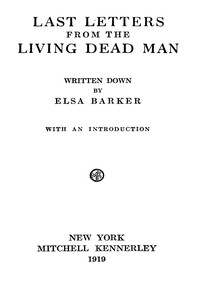
Last letters from the living dead man — Themes and Context
(0 User reviews)
162
Project Gutenberg
2025
Not confirmed
Spiritualism; Spirit writings; World War, 1914-1918 -- Miscellanea
Readers of public-domain and historical texts
Project Gutenberg digital edition
en
Edition facts
Words
34,703
Reading time
151 min
Text sections
36
The catalog record for Last letters from the living dead man — Themes and Context provides practical reading context through 34,703 words, 2 hr 31 min estimated reading time, and 36 detected text sections.
The text analysis averages about 18.4 words per sentence, while the detected sections provide another way to judge how the source is divided.
Project Gutenberg metadata also associates the work with “Spiritualism,” connecting these edition facts with the source record’s subject description.
Source:
Project Gutenberg record #76990
The third volume of automatic writings attributed to a deceased spirit, composed during 1917–1918, presents a series of letters blending spiritualist philosophy with commentary on World War I and American destiny.
Read the complete public-domain text at its original source.
Read on Project GutenbergThe book opens with an introduction in which Elsa Barker describes how she lost the ability to do automatic writing after February 1918, only later realizing that the manuscript she had set aside was a complete, organic whole. She notes that the text, written between February 1917 and February 1918, now reads as timely as yesterday's editorials. This framing immediately establishes the work as a product of its historical moment, shaped by the war and by Barker's own shifting psychic receptivity.
Structure as Discovery
The table of contents lists thirty-one letters with titles such as “The Genius of America,” “Fear Not,” and “The Promise of Spring.” Barker’s introduction reveals that she originally considered the manuscript a fragment; only upon rereading did she perceive its completeness. This retrospective recognition of structure mirrors the book’s own themes of hidden order and gradual revelation. The letters move from broad geopolitical concerns to more personal and philosophical reflections, suggesting a deliberate arc even if the composition was spontaneous.
Recurring Images of Nature and the Land
Throughout the excerpts, natural settings serve as backdrops for spiritual encounters. In one passage, the narrator meets a Native American figure in a pine grove, where “the fresh odor of the pine grove was keen in my senses.” The figure throws back his head “with a splendid motion as if to drink it in.” Trees and forests appear repeatedly, often as places of council or communion. The letter titled “Trees and Brick Walls” further signals this contrast between organic and constructed environments. These images ground abstract spiritual discussions in sensory, earthly details.
Movement Between Worlds and Minds
The narrative frequently shifts between the material and the spiritual, often through mind-to-mind communication. In the excerpt, the narrator “cast aside the veil” to allow the other to see “mind to mind.” The text emphasizes the difficulty of translating such exchanges into words: “It is difficult to translate in words the rapid give and take of our thoughts, the pictures that flashed back and forth.” This emphasis on non-verbal understanding underscores the book’s central conceit of communication across the boundary of death.
The Native American Encounter as a Turning Point
One of the most vivid episodes involves a dialogue with a Native American figure described as a “kind of priest of retribution.” The narrator seeks to persuade him that the welfare of his race does not require the destruction of the white race, and explains the concept of reincarnation—that many of his people have returned “in material form to that America they had loved before.” The figure responds with a series of critical images of white American life: a schoolhouse with a “choking-hot stove,” a “meeting-house” with a droning preacher, and an office where clerks bend over ledgers of “figures, figures, long lines of figures.” This exchange dramatizes a clash of worldviews and offers a pointed social critique embedded within the spiritualist framework.
Readers approaching this work should attend to the interplay between its claimed supernatural origin and its concrete historical references. The letters were written during the final year of World War I, and their concerns—national destiny, unity, fear, and reconstruction—reflect that context. Barker’s own role as amanuensis, and her eventual loss of the automatic writing ability, adds another layer to the question of authorship and intention.
There were evenings reading those letters where the dead spoke of rhythm in war and spirit, and I kept thinking of an older voice, one that sorted tragedy into parts. That old Greek grammar of feeling seemed almost like a quiet reply to the chaos. It made me fetch Aristotle on the art of poetry — Themes and Context, just to sit with both for a while.
There are no reviews for this eBook.
There are no comments for this eBook.
Reader reflection
What was your reading experience?
Capture what you thought, learned, and would like to remember.
Your progress
0
/
10
2
Did this book hold your interest?
3
Would you recommend this book to another reader?
4
How easy was the book to follow?
5
What was its emotional impact?
6
Would you read this book again?
7
Would you start a conversation about this book?
8
How strong was your personal connection to the text?
9
What changed or sharpened your thinking?
10