1

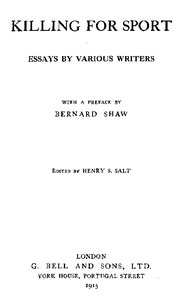
Killing for Sport: Essays by Various Writers — Key Ideas to Explore
(0 User reviews)
114
Project Gutenberg
2015
Not confirmed
Animal welfare; Hunting -- Religious aspects; Hunting -- Moral and ethical aspects
Readers of public-domain and historical texts
Project Gutenberg digital edition
en
Edition facts
Words
58,102
Reading time
253 min
Text sections
8
This digital edition of Killing for Sport: Essays by Various Writers — Key Ideas to Explore is described by source-level measurements including 58,102 words, 4 hr 13 min estimated reading time, and 8 detected text sections.
The text analysis averages about 26.8 words per sentence, while the detected sections provide another way to judge how the source is divided.
Project Gutenberg metadata also associates the work with “Animal welfare,” connecting these edition facts with the source record’s subject description.
Source:
Project Gutenberg record #49097
This 1915 collection, edited by Henry S. Salt with a preface by Bernard Shaw, assembles essays arguing against blood sports. The essays employ a range of rhetorical strategies, from statistical economic arguments to moral and aesthetic appeals, and frequently shift between measured analysis and indignant condemnation.
Read the complete public-domain text at its original source.
Read on Project GutenbergThe volume opens with a note from the Humanitarian League that immediately establishes a careful distinction: it approves of “fair and manly recreations” like cricket and rowing while condemning “blood-sports” that involve the death or torture of sentient beings. This measured, almost legalistic tone sets the stage for a collection that often alternates between cool-headed argument and outright indignation. The preface by Bernard Shaw, though not excerpted here, signals the combative and witty voice that readers will encounter throughout.
Rhetorical Shifts: From Economic Calculation to Moral Outrage
The essays frequently pivot between two distinct registers. In the excerpt from the essay on game-preserving, the writer adopts a quasi-statistical tone, noting that “the Scottish deer forests alone cover an area of over two million acres” and citing the Land Enquiry Committee. This appeal to measurable loss—land that could rear sheep is instead kept barren—is then undercut by a sudden rhetorical escalation: “For this are vast areas kept barren, whilst millions hunger for the produce which they might have yielded.” The repetition of “For this” builds a cumulative, almost biblical rhythm, culminating in the sarcastic exclamation “And we think ourselves a practical people!”
This pattern recurs in E. B. Lloyd’s essay on the destruction of wild life. Lloyd begins by noting a frequently overlooked consequence of game-bird shooting—the collateral destruction of non-game species—and cites Sir Harry Johnston on the “æsthetic value of wild animals.” But the tone soon sharpens: the gamekeeper is called “the most ruthless of beasts of prey,” and the essay moves from reasoned observation to a catalog of keeper abuses, including shooting “any strange or rare bird that strikes his fancy.” The shift from dispassionate analysis to moral condemnation is a hallmark of the collection’s persuasive strategy.
The Gamekeeper as Antagonist: A Recurring Figure
Across the excerpts, the gamekeeper emerges as a symbolic and literal villain. Lloyd describes him as acting from “abysmal ignorance” of ecological relationships, and as possessing the power to shoot protected species “either for amusement or profit.” This characterization is not merely anecdotal; it serves as a concrete embodiment of the systemic cruelty the essays attack. The gamekeeper is not an individual but a type—the agent of a system that prioritizes a supply of game birds over all other forms of life.
The earlier note from the Humanitarian League similarly invokes a systemic view, tracing the failure of legislation since the 1849 and 1854 Acts, which gave no protection to wild animals. The gamekeeper, then, is the visible enforcer of a legal and economic structure that the essays seek to dismantle. By focusing on this figure, the writers make abstract arguments about cruelty and land use tangible and personal.
The Aesthetic Argument: Beauty as a Counterweight to Utility
While many essays rely on economic or moral reasoning, a distinct strand appeals to aesthetic and intellectual values. Lloyd quotes Sir Harry Johnston on the “æsthetic value of wild animals in our landscape” and argues that British game birds “cannot compare, for interest and beauty, with many of the species which are sacrificed on their behalf.” This is a notable shift: the argument is not that killing is cruel or wasteful, but that it diminishes the natural world’s beauty and intellectual stimulation.
The same essay laments the absence of a National Park or reserve comparable to Yellowstone or the Swedish Wild Park, implying that preservation for its own sake is a legitimate goal. This aesthetic thread runs alongside the more pragmatic arguments, offering a different kind of appeal—one that values wild life not for its utility but for its intrinsic worth and the enrichment it provides to human experience. The contrast between this elevated tone and the earlier economic calculations highlights the collection’s varied rhetorical toolkit.
Readers should attend to how each essay selects its evidence—whether statistical, legal, anecdotal, or aesthetic—and how the tone shifts within a single piece. The collection does not maintain a uniform voice; instead, it orchestrates a chorus of arguments that sometimes harmonize and sometimes clash. Pay particular attention to moments where the writer steps back from analysis to deliver a sharp rhetorical blow, as these reveal the emotional core beneath the reasoned surface.
I finished that old Salt collection and found myself oddly grateful for its quiet fury, how it judges without flinching. It made me think of another peculiar passion—the way we cling to objects, words, meaning. That book, Bibliomania; or Book-Madness A Bibliographical Romance — Reading Companion, understands that same tender ache, the longing behind our collections, and it stayed with me just as softly.
There are no reviews for this eBook.
There are no comments for this eBook.
Reader reflection
Record your reading impressions
A brief reflection can help important ideas stay with you longer.
Your progress
0
/
10
2
How much did you enjoy the reading experience?
3
Would you encourage someone else to read it?
4
How demanding did the text feel?
5
How clearly were the main ideas presented?
6
How did the pace of the book feel?
7
Would you like to discuss this book with someone?
8
Did this book create an emotional response?
9
In one sentence, what did you learn?
10