1

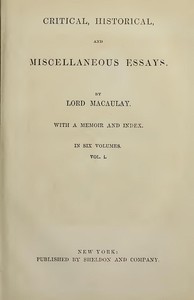
Critical, Historical, and Miscellaneous Essays; Vol. 1 With a Memoir and Index — Key Ideas to Explore
(0 User reviews)
1502
Project Gutenberg
2017
Not confirmed
Macaulay, Thomas Babington Macaulay, Baron, 1800-1859; Great Britain -- History; English literature -- History and criticism
Readers of public-domain and historical texts
Project Gutenberg digital edition
en
Edition facts
Words
194,386
Reading time
846 min
Text sections
35
The catalog record for Critical, Historical, and Miscellaneous Essays; Vol. 1 With a Memoir and Index — Key Ideas to Explore provides practical reading context through 194,386 words, 14 hr 6 min estimated reading time, and 35 detected text sections.
The text analysis averages about 23.4 words per sentence, while the detected sections provide another way to judge how the source is divided.
Project Gutenberg metadata also associates the work with “Macaulay, Thomas Babington Macaulay, Baron, 1800-1859,” connecting these edition facts with the source record’s subject description.
Source:
Project Gutenberg record #55901
This editorial note examines how Macaulay's opening, middle, and later essays guide a first reading, focusing on his critical method, historical perspective, and stylistic choices as revealed in the excerpts.
Read the complete public-domain text at its original source.
Read on Project GutenbergMacaulay's first volume of essays opens with a publisher's advertisement that emphasizes the chronological arrangement of the pieces, claiming this order offers 'a complete biographical portraiture of the brilliant author's mind.' This framing invites the reader to treat the collection as an intellectual autobiography. The earliest essays, such as 'Fragments of a Roman Tale' and 'Scenes from Athenian Revels,' show Macaulay experimenting with imaginative forms before turning to the critical and historical works for which he is known. The reader is thus primed to observe how his voice and method develop across the volume.
The Critical Stance in the Early Essays
In the excerpt from the essay on poetry, Macaulay argues that 'the creative faculty, and the critical faculty, cannot exist together in their highest perfection.' He illustrates this with the example of Hotspur, noting that a catalogue of traits fails to capture the character's essence. This passage reveals his analytical approach: he breaks down a subject to expose the limits of analysis itself. The reader new to Macaulay will encounter a critic who is simultaneously self-aware and assertive, using concrete examples to ground abstract claims. His prose is dense with analogies—the porcupine, the machine—that clarify his reasoning without oversimplifying.
Historical Essays as a Window to Method
The volume includes essays on Milton, Machiavelli, and Hallam, among others. In these, Macaulay applies the critical principles outlined earlier to historical figures and periods. The excerpt on poetry suggests he will judge historical works not merely for accuracy but for their power to convey 'the very element by which poetry is poetry.' Readers should watch for how he balances factual detail with rhetorical flourish. His treatment of Milton, for instance, likely combines biographical narrative with literary evaluation, a pattern that recurs throughout the collection. The chronological arrangement allows one to trace how his historical perspective deepens over time.
The Role of the Memoir and Index
This edition includes a biographical sketch by Edwin Percy Whipple and a full index. The publisher's advertisement boasts that the index allows reference to 'the vast stores of historical learning and pertinent anecdote' without requiring a memory equal to Macaulay's own. For a first reading, the memoir provides context for the essays' composition, while the index serves as a tool for navigating the volume's range of topics. Readers might consult the index to locate recurring themes—such as Macaulay's views on liberty or his assessments of particular authors—and compare how his judgments evolve across essays written years apart.
Stylistic Consistency Across Genres
Even in the early imaginative pieces like 'A Prophetic Account of a Grand National Epic Poem,' Macaulay's voice is unmistakable: balanced clauses, pointed antitheses, and a tone of urbane authority. The excerpt from the critical essay shows his preference for vivid illustration over dry abstraction. This stylistic consistency means that a reader encountering any essay in the volume will quickly recognize Macaulay's manner. However, the subject matter shifts dramatically—from ancient Rome to contemporary politics—so the challenge is to see how his method adapts to different materials. The later essays, such as those on history, likely test his critical framework against larger narratives.
Reading this volume chronologically, as the publisher recommends, allows one to observe Macaulay's intellectual range and his persistent concern with the relationship between analysis and creativity. The excerpts suggest that his essays reward attention to both argument and style: he is as interested in how he makes his case as in the case itself. A first-time reader may find it useful to start with the shorter, more playful pieces before tackling the longer historical essays, using the index to track recurring ideas. The volume stands as a record of a mind in motion, not a static collection of opinions.
I keep thinking about how Macaulay's essays feel less like arguments and more like quiet conversations about time, the way a person's laughter lingers after they've left a room. There's something in that same spirit found in Laughter: An Essay on the Meaning of the Comic — Text and Context, where humor becomes a gentle lens for understanding why we pause, smile, and hold a moment close.
There are no reviews for this eBook.
There are no comments for this eBook.
Reader reflection
What was your reading experience?
Capture what you thought, learned, and would like to remember.
Your progress
0
/
10
2
Did this book hold your interest?
3
Would you encourage someone else to read it?
4
Did the language feel accessible?
5
How distinctive were its ideas or approach?
6
How valuable was this book for your own interests?
7
Could you see yourself revisiting this book?
8
Did any part of the book feel personally relevant?
9
Which lesson or insight stayed with you?
10