1

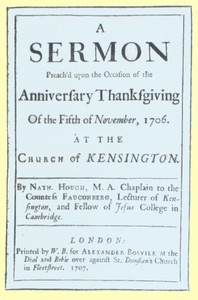
A Sermon Preach'd upon the Occasion of the Anniversary Thanksgiving of the Fifth of November, 1706 at the Church of Kensington — Text and Context
(0 User reviews)
1531
Project Gutenberg
2020
Not confirmed
Sermons, English -- 18th century; Gunpowder Plot, 1605; Gunpowder Plot, 1605 -- Anniversaries, etc. -- Sermons -- Early works to 1800; Anti-Catholicism -- England -- Sermons -- Early works to 1800
Readers of public-domain and historical texts
Project Gutenberg digital edition
en
Edition facts
Words
7,961
Reading time
35 min
Text sections
1
The catalog record for A Sermon Preach'd upon the Occasion of the Anniversary Thanksgiving of the Fifth of November, 1706 at the Church of Kensington — Text and Context provides practical reading context through 7,961 words, 35 min estimated reading time, and 1 detected text section.
The text analysis averages about 28.5 words per sentence, while the detected sections provide another way to judge how the source is divided.
Project Gutenberg metadata also associates the work with “Sermons, English -- 18th century,” connecting these edition facts with the source record’s subject description.
Source:
Project Gutenberg record #61990
Nathaniel Hough's 1706 sermon for the November 5th thanksgiving uses Psalm 124 to frame the Gunpowder Plot as a providential deliverance, then draws a parallel to the 'second deliverance' of the Glorious Revolution, contrasting divine rescue with the threat of 'Popery' and 'perpetual Night.'
Read the complete public-domain text at its original source.
Read on Project GutenbergNathaniel Hough, chaplain to the Countess Fauconberg and lecturer of Kensington, preached this sermon on November 5, 1706, an anniversary thanksgiving for the Gunpowder Plot. He opens by aligning Psalm 124 with the day's events, claiming the psalmist's language—'swallowing up quick,' 'the snare of the fowler'—fits the plot so exactly that 'whilst We sing an Hymn, we seem likewise to read a Prophecy.' Hough immediately acknowledges a tension: the recent military victories of 1706 have 'drain’d our very best Acknowledgments,' leaving gratitude for older mercies depleted. This double awareness—of present triumphs and past deliverance—shapes the sermon's argument that the 1605 plot and the Glorious Revolution of 1688 are 'both have a like Place in the Offices of the Church' and should be remembered together.
Two Deliverances, One Calendar
Hough structures his sermon around what he calls a 'Half-view' of the day: the Gunpowder Plot is only half the story. The 'second Deliverance of later Date'—the Glorious Revolution—is 'very much of the same kind' with 'the Adversaries the same, the Hazard as great.' He declines to give a full account of the later event, calling it 'Unnecessary' because it lives in listeners' memories and 'Indecent' because it might question their gratitude. Instead, he uses the parallel to heighten the first deliverance: 'One serves to heighten and advance the Other, tho’ each of them singly stands above Acknowledgment.' This pairing allows Hough to fold contemporary anti-Catholic sentiment into a providential framework, treating both escapes as evidence of divine favor toward Protestant Britain.
The Language of Peril and Rescue
Hough's imagery draws heavily on Old Testament tropes of sudden destruction and escape. The plotters are 'base Workers of Iniquity' who 'labour’d for our Overthrow, as the Miner for his Oar,' and their scheme is a 'Hellish Forge.' Yet the deliverance is equally vivid: 'Heaven sent a sudden Damp upon their Designs,' and the plot was 'conceal’d from Us, till ’twas prevented, that We might labour under no Confusion.' The sermon repeatedly contrasts the plotters' hidden work with the openness of God's intervention. Hough also employs a striking temporal paradox: 'No Peril was ever more imminent, and yet our Deliverance scarce put Us to the Expence of a Fright; And without Time for being troubled, We saw our Danger, and gave our Thanks.' This compression of fear and gratitude is a rhetorical centerpiece.
The Threat of Popery as Present Danger
Though the sermon commemorates an event a century old, Hough treats Catholicism as an immediate menace. He recalls the 'dreadful Apprehensions of approaching Popery' not twenty years before the sermon, when 'Liberty and Religion, the two great Blessings of Humane Life, were taking their flight from this melancholy Island.' The description of the 1680s crisis is visceral: 'Our Ark was actually tottering,' Bibles might be 'shut,' and 'The Host was daily expected in our Streets, the next was Flame and Faggot for not adoring it.' Hough even notes that prayers were offered 'in an unknown Language'—English whispered in private—because public worship was unsafe. This section grounds the sermon's anti-Catholic rhetoric in lived memory, not just historical commemoration.
Hough's sermon is best read as a piece of occasional rhetoric that weaves together scriptural typology, national history, and contemporary politics. Readers should note how he balances the two deliverances—1605 and 1688—without letting either overshadow the other, and how his vivid, almost sensory language of 'Flame and Faggot' and 'perpetual Night' works to make a century-old plot feel urgent. The dedication to the parishioners of Kensington, 'the best Subjects to Her Majesty, as well as the nearest Neighbours to Her Court,' hints at the sermon's local and political context, which the text itself only partly reveals.
Reading this sermon’s account of gratitude for narrow escapes, I thought of my grandmother’s old copy of Literary Hearthstones of Dixie — Story, Setting & Ideas, and how its quiet reverence for place felt like a homecoming the way Hough’s words must have felt to his congregation — a sense that safety, too, can be a kind of inheritance.
There are no reviews for this eBook.
There are no comments for this eBook.
Reader reflection
Take a moment to reflect on this book
Create a short personal record of your experience with this book.
Your progress
0
/
10
2
How much did you enjoy the reading experience?
3
Is this a title you would suggest to others?
4
How much effort did this book require?
5
Could you apply anything you learned?
6
How strong was your personal connection to the text?
7
Did any part of the book stay with you emotionally?
8
Could you see yourself revisiting this book?
9
In one sentence, what did you learn?
10