
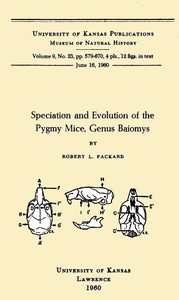
Speciation and Evolution of the Pygmy Mice, Genus Baiomys by Robert L. Packard
Let's be clear: this isn't a novel. There's no protagonist named Benny the Brave Mouse. Instead, Robert Packard presents a real-world puzzle centered on the genus Baiomys, the pygmy mice. These are some of the smallest rodents on the continent, and for a long time, scientists weren't sure if they were looking at one variable species or two distinct ones. Packard's book is his report from the field and the museum, laying out all the evidence.
The Story
The 'plot' follows Packard's investigation. He starts by introducing us to these elusive mice and the big question: one species or two? Then, he becomes a biological detective. He compares hundreds of museum specimens, measuring skulls and teeth down to the millimeter, looking for consistent differences. He maps where they were found, looking for geographical barriers like rivers or mountains that could have separated populations. He examines their habitats—do they live in different grasses, eat different seeds? Chapter by chapter, he adds a new piece of data. By the end, the cumulative evidence points strongly to two separate evolutionary paths. The story is the slow, careful process of scientific discovery itself, revealing how isolation and time can rewrite a species' blueprint.
Why You Should Read It
I loved this book for its focus and clarity. It takes a single, precise question and answers it thoroughly. There's a real satisfaction in watching the argument build. You see how science worked in a pre-computer age, relying on sharp eyes, careful hands, and logical deduction. It's also a humble reminder of how much diversity is hidden in plain sight. These mice were overlooked for years because they're small and look alike. Packard shows us that paying close attention to the 'ordinary' can reveal extraordinary evolutionary stories. It makes you look at any patch of grass and wonder what tiny dramas of speciation might be unfolding there.
Final Verdict
This is a specialized book, but its appeal is broader than you might think. It's perfect for natural history enthusiasts, biology students, or anyone curious about how scientists actually do their work. If you enjoyed books like The Song of the Dodo by David Quammen but want a more focused, technical case study, this is for you. It's not a light beach read; it demands your attention. But if you give it, you'll be rewarded with a masterclass in scientific reasoning and a deep appreciation for the small wonders of evolution.
Elizabeth Garcia
7 months agoThis book was worth my time since the atmosphere created is totally immersive. I learned so much from this.




John Miller
2 years agoBased on the summary, I decided to read it and the arguments are well-supported by credible references. I learned so much from this.