
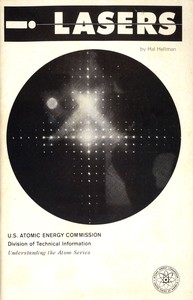
Lasers by Hal Hellman
Hal Hellman's Lasers is a time capsule from the dawn of a technology that now feels utterly ordinary. Written in the late 1960s, just a few years after the first working laser was built, it captures the excitement and sheer novelty of the invention. Hellman doesn't assume you have a PhD. Instead, he starts with a simple question: what is light, really? From there, he builds up the principles behind the laser—stimulated emission, coherence, amplification—in plain language. The book charts the theoretical groundwork laid by Einstein, through the post-war radar research that provided key tools, to the frantic race in American laboratories to build the first working device.
The Story
The 'plot' follows the laser's journey from a thought experiment to a physical object. It's a story of incremental progress and sudden breakthroughs. Hellman introduces you to the key players—like Charles Townes and Gordon Gould—and the sometimes messy disputes over who invented what. He explains the early, clunky prototypes (some filled with toxic gases!) and then explores the immediate question everyone had: 'Okay, we made it... but what do we do with it?' The book ends looking forward, speculating on future uses in medicine, communication, and even warfare, many of which have since come true.
Why You Should Read It
I loved this book because it makes you appreciate the technology in your pocket. We're surrounded by lasers—in grocery scanners, fiber optic internet, medical devices—and we never think about them. Hellman's book brings back the wonder. He has a knack for clear metaphors (comparing light amplification to a snowball rolling down a hill, gathering more snow) that make complex physics click. Reading it today is also a fun history lesson; you get to see which predictions were spot-on and which were charmingly off-base. It’s a celebration of human curiosity.
Final Verdict
This is the perfect book for anyone with a casual interest in science history or who enjoys stories about how things work. It's for the person who watches a documentary on the History Channel and thinks, 'Huh, I want to know more.' It's short, clearly written, and packed with the kind of 'aha!' moments that make you look at the modern world differently. If you've ever pointed a laser pointer at a wall and wondered how that tiny red dot is possible, Hellman has your answer, served with a big dose of 1960s optimism.
Michelle Davis
1 year agoRecommended.
Richard Lopez
1 year agoWithout a doubt, the storytelling feels authentic and emotionally grounded. Absolutely essential reading.









Lucas Sanchez
5 months agoI came across this while browsing and the flow of the text seems very fluid. Exceeded all my expectations.