
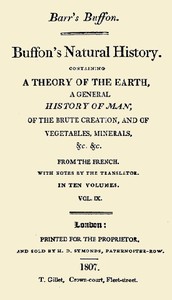
Buffon's Natural History. Volume 09 (of 10) by Buffon
This isn't a novel, so there's no plot in the traditional sense. Think of it as a grand, ambitious project. In Volume 9, Buffon focuses entirely on the world of birds. He methodically works his way through different groups, describing their physical forms, behaviors, habitats, and migration patterns. He talks about songbirds, birds of prey, waterfowl, and more. The 'story' is the unfolding of his system. He's not just listing facts; he's comparing, contrasting, and trying to find the underlying order in nature. He argues against some of the rigid classification systems of his contemporaries, favoring a more fluid approach based on observation. The book is his attempt to make sense of a dizzying amount of information and present a coherent picture of this one branch of the animal kingdom.
Why You Should Read It
You should read this because it lets you sit on the shoulder of a scientific pioneer. Buffon's writing has a real personality. You can feel his curiosity and sometimes his frustration. When he describes the flight of an eagle or the delicate nest of a small bird, his wonder is contagious. It's easy to forget this was written 250 years ago. Yes, some of the science is outdated (he had some... interesting ideas about animal intelligence and degeneration), but that's part of the fascination. Reading this is like a time-travel experiment. You get a front-row seat to the birth of modern biology. You see how ideas are formed, tested, and sometimes missed. His respect for the complexity of nature feels very modern.
Final Verdict
This book is perfect for curious minds who love history, science, or just great observational writing. It's not a quick, easy read—it requires a bit of patience—but it's deeply rewarding. If you enjoy authors like David Attenborough or naturalists like John Muir, you'll appreciate Buffon as a kind of philosophical ancestor. It's also great for anyone who likes to see how big ideas develop. Don't go in expecting a field guide. Go in expecting a conversation with a brilliant, passionate thinker from the Age of Enlightenment, and you'll be blown away by how engaging a book about 18th-century ornithology can be.
Emma Young
1 year agoBased on the summary, I decided to read it and the content flows smoothly from one chapter to the next. Absolutely essential reading.
Lucas Jones
8 months agoFast paced, good book.
Joshua Johnson
2 years agoWithout a doubt, the author's voice is distinct and makes complex topics easy to digest. Highly recommended.
Sandra Perez
1 year agoUsed this for my thesis, incredibly useful.



Daniel Brown
1 year agoSimply put, the atmosphere created is totally immersive. Exceeded all my expectations.